



How long does a DNA test take? The short answer
For a standard paternity or relationship DNA test, results are typically ready in 2 to 3 business days after the samples reach the laboratory — not two to three days after you first call. Prenatal paternity testing runs 5 to 7 business days because the laboratory has to isolate the baby’s DNA from the mother’s bloodstream first.
- Collection day counts as day zero. A mobile collector can usually be at your home, office or hospital room the same day you book.
- Legal, court-admissible testing follows the same laboratory science but adds identity verification and chain-of-custody paperwork, so plan on 2 to 3 business days end to end.
- Business days are not calendar days. A Thursday collection often means a Monday or Tuesday report.
- Rush processing exists for genuine deadlines and carries an additional laboratory fee. Ask before you book, not after.
Almost nobody asks how long a DNA test takes out of curiosity. People ask because there is a hearing on the calendar, a birth certificate waiting to be amended, a deployment date, or simply a question that has been sitting in the middle of a family for months. The waiting is the hardest part of the process, and vague answers make it worse.
This guide breaks the timeline down honestly: what happens on each day, which parts are laboratory science that cannot be rushed, which parts are logistics that absolutely can be, and where most of the lost time actually goes. Spoiler: it is rarely the laboratory.
Understanding DNA test processing times
Every published turnaround time you will see — ours included — is measured from sample receipt at the laboratory, not from the moment you decide to get tested. That distinction matters enormously, because the days people lose are almost always on the front end: waiting for an appointment slot, driving to a collection site, coordinating two adults and a child into the same room during business hours.
The laboratory portion is remarkably consistent. DNA extraction, amplification, analysis of the genetic markers and quality-control review are automated, validated processes that run on a fixed schedule. A laboratory does not get faster because your case is urgent; it gets faster only when a sample is physically moved to the front of a batch, which is what expedited processing buys.
So the practical formula is:
Total time = time to get sampled + shipping time + laboratory processing + reporting.
Three of those four are logistics. Only one is science. That is why mobile collection changes the calendar so dramatically — it collapses the first term to zero.
Timeline for different types of DNA tests
Paternity test results timeline
A standard cheek-swab paternity test is the fastest thing in relationship testing. The laboratory compares genetic markers between the alleged father and the child, and the mathematics resolve quickly and unambiguously. Expect 2 to 3 business days from sample receipt for both private (peace-of-mind) and legal testing.
Where the two diverge is documentation. A legal paternity DNA test requires photo identification, witnessed collection, tamper-evident sealing and an unbroken chain of custody from swab to report. None of that slows the science down, but it does mean the report is assembled and reviewed more carefully before release, which is why legal cases are usually quoted at 2 to 3 business days end to end. A private non-legal test skips the paperwork, not the accuracy — the difference is admissibility, as explained in our breakdown of legal versus non-legal DNA testing.
Three things most often add a day to a paternity case: a participant who cannot attend the collection, an incomplete case form, or a child who has eaten or had a bottle within 30 minutes of swabbing.
Relationship DNA tests: siblingship, grandparent, avuncular
When the alleged father is unavailable, deceased or unwilling, the biological question gets answered indirectly — through a siblingship test, a grandparent test, or an avuncular (aunt or uncle) test. Our laboratory reports these in the same 2 to 3 business day window as paternity, and twin zygosity testing follows the same schedule.
Some laboratories quote 5 to 7 days for these cases, and there is a real reason behind the longer figure. Indirect relationships produce statistical likelihoods rather than the near-binary answer paternity gives, so more markers are analysed and the calculation is more involved. Adding the child’s mother to a siblingship case, when she is available, sharpens the result considerably and is worth doing even though it means coordinating one more participant.
If a case comes back inconclusive — which happens more often with distant relationships than with paternity — the laboratory may recommend testing an additional relative. That restarts the clock, which is exactly why getting the right participants into the first collection matters so much.
Prenatal paternity testing
A non-invasive prenatal paternity test takes longer than any other relationship test we handle: 5 to 7 business days. It is a genuinely different laboratory process. Rather than reading DNA off a cheek swab, the laboratory isolates cell-free fetal DNA circulating in the mother’s bloodstream, separates it from her own DNA, and then performs the comparison. That extraction step is the added time — and the reason prenatal testing costs several times what a standard test costs.
It requires a blood draw from the mother (from about the 7th week of pregnancy) plus a simple cheek swab from the alleged father, and it carries no risk to the pregnancy.
Immigration DNA testing
Immigration DNA testing is worth understanding because the timeline works differently, and because people frequently assume any DNA provider can handle it. Federal immigration petitions run through a separate process using specifically approved providers, with results delivered directly to the requesting agency, consulate or embassy rather than to the family. Realistic timelines run considerably longer than domestic relationship testing once agency coordination and international shipping are counted.
Odosek does not perform immigration DNA collections. If your matter is an immigration petition, contact us and we will point you toward an approved provider rather than sell you a test that will not be accepted.
What factors affect DNA test turnaround?
| Factor | Typical impact | How to avoid losing time |
|---|---|---|
| Getting an appointment | 1–5 days — usually the single biggest delay | Use mobile collection; a collector comes to you, often same day |
| Shipping to the laboratory | 1–2 days | Same-day dispatch with tracked overnight courier |
| All participants present | Adds a full collection cycle if someone is missing | Confirm every participant before the appointment is set |
| Sample quality | Recollection adds 2–4 days | No food, drink, gum or smoking for 30 minutes before swabbing |
| Test complexity | Prenatal adds 3–4 days; distant relationships add analysis | Pick the most direct relationship available to test |
| Legal documentation | Adds review time, not laboratory time | Bring valid photo ID; have the case form filled out in advance |
| Laboratory volume | Seasonal peaks can add a day | Ask about rush processing if you are near a deadline |
| Weekends and holidays | Turns 3 business days into 5 calendar days | Book collection early in the week when possible |
Read that table again and notice the pattern: nearly every controllable delay happens before the sample reaches the laboratory. The science is the predictable part.
How mobile DNA testing changes the clock
This is the part people underestimate. When a certified collector comes to your home, workplace, attorney’s office or a hospital room, three separate delays disappear at once: the appointment queue, the travel, and the coordination problem of getting several people to the same address during business hours. Samples are collected, sealed and dispatched the same day.
For court matters, mobile collection also protects the thing that makes the result usable: chain of custody is established at your kitchen table, witnessed and documented, exactly as it would be at a facility. We cover this in more depth in five reasons to choose mobile DNA testing over a lab visit and in our guide to mobile lab testing services.
Steps in the DNA testing process and how long each one takes
Stage 1 — sample collection (day zero, about 15 minutes)
A certified collector meets you wherever you are in South Carolina, Georgia or Maryland. Photo identification is checked and photographed for legal cases, participants are documented, and buccal (cheek) swabs are taken — a painless 5 to 10 second rub on the inside of each cheek, safe for newborns. Samples are sealed in tamper-evident packaging in front of you, and the chain-of-custody form is signed on the spot. The whole appointment usually takes under 15 minutes for two people. If you are worried about a young child, our guide on preparing children for a DNA test helps.
Stage 2 — transport (same day dispatch, 1 to 2 days in transit)
Sealed samples go out by tracked courier the same day whenever the collection happens before the daily cutoff. Cheek swabs are stable at room temperature, so no refrigeration or special handling is needed — one of the reasons swabs have replaced blood draws for relationship testing.

Stage 3 — laboratory analysis (2 to 3 business days)
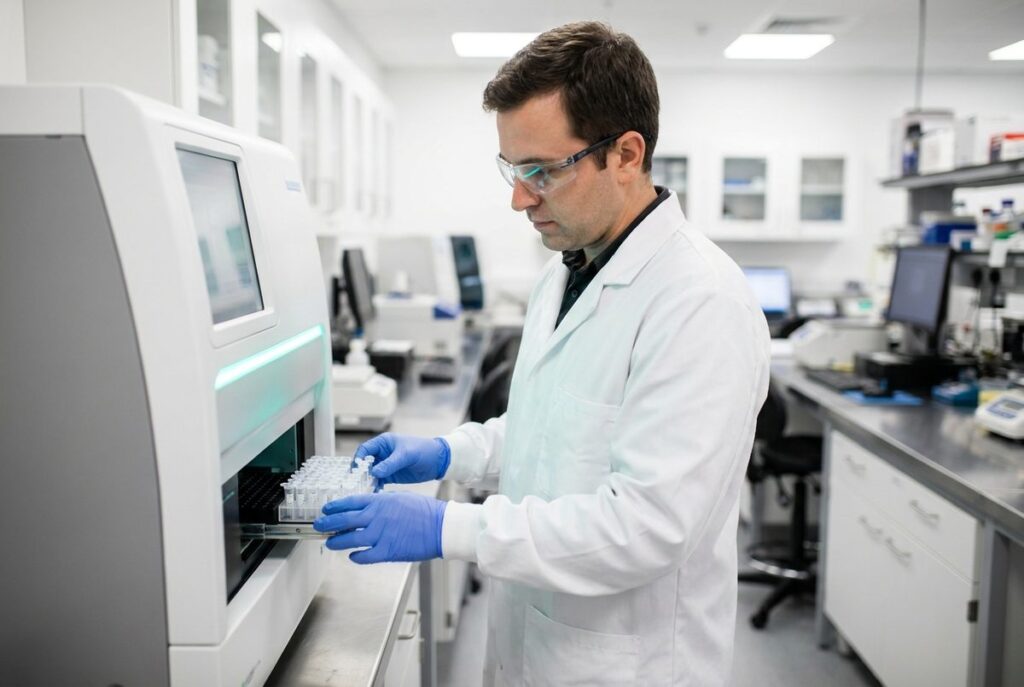
At the AABB-accredited laboratory that processes our samples, the DNA is extracted and purified, target regions are amplified, and a panel of genetic markers is analysed and compared between participants. Every case is run through quality control, and legal cases are independently reviewed by a second analyst before release. Deeper detail lives in what DNA is and how DNA testing works.
Stage 4 — review and delivery (the final day)
A doctoral-level reviewer signs off on the report, and results are released to the named parties only — through a secure portal, by email, by mail, or by phone if you have asked for that. For court cases the certified report goes to the attorney or the court as directed. Nobody else receives it, and results are never released to a third party who was not part of the case.
Can you expedite DNA test results?
Yes. Rush processing moves your case to the front of the laboratory queue and typically compresses analysis by a day or more. It carries an additional laboratory fee, and it must be arranged at the time of booking — a sample already sitting in a standard batch usually cannot be pulled forward.
Situations where people legitimately need it:
- A hearing date inside the week, particularly in child support or custody matters
- A court-ordered test with a filing deadline attached
- A newborn still in hospital, where a birth certificate decision is being made
- A military deployment, relocation or travel window closing
- An adoption or estate proceeding with a statutory clock running
What rush processing does not do is produce same-day results. Same-day collection is realistic and we do it every day; same-day results are not, because extraction, amplification and quality control take the time they take. Any provider promising a laboratory-grade relationship result in a few hours deserves a hard question about which laboratory is doing the work. Our article on same-day DNA testing services explains where the line honestly falls.
Working against a deadline?
Tell us the date. We schedule mobile collection 24/7 across South Carolina, Georgia and Maryland, and we will tell you plainly whether your timeline is achievable before you pay for anything.
What happens after your samples are collected?
Sealed samples travel by tracked courier to the laboratory, where they are logged in, assigned a case number and matched against the chain-of-custody paperwork. That log-in event is the moment your published turnaround time starts, and it is the moment worth asking about if you want to know exactly where you stand.
During processing there is genuinely nothing to report — no partial results, no running commentary. Silence during the standard window is normal and is not a sign of a problem. You are welcome to call and confirm that samples arrived; a live representative answers 24/7.
If results run past the quoted window, the usual causes are mundane: a shipping delay, a sample that yielded insufficient DNA, or a missing signature on a case form. Call us and we will chase the laboratory directly. When a recollection is needed because of a sample-quality issue on our side, we come back out and re-swab at no charge.
Are fast DNA results as accurate as slow ones?
Speed and accuracy are not on the same dial. A paternity inclusion is reported at a probability of 99.9% or greater, and an exclusion is definitive at 100% — the same standards apply whether the case ran on a standard schedule or a rush one. Rush processing changes a sample’s place in the queue; it does not skip extraction, replicate testing or quality-control review.
The safeguard behind that is accreditation. Samples are processed at an AABB-accredited laboratory, which means the facility is audited against published relationship-testing standards covering validation, technician competency, replicate analysis and documentation. Those requirements apply to every case, at every speed. For the fuller picture see how accurate DNA tests really are and can a paternity test be wrong.
Lab-based collection versus mobile collection
| Stage | Lab or clinic appointment | Mobile collection |
|---|---|---|
| Getting scheduled | Next available slot, often 2–5 days out, business hours only | Often same day, including evenings and weekends |
| Getting there | Every participant travels to one facility | Collector travels to you; participants can be split across addresses |
| Time on the day | 1–3 hours including travel and waiting | About 15 minutes |
| Chain of custody | Established at the facility | Established on site, witnessed and documented identically |
| Laboratory processing | 2–3 business days | 2–3 business days — same laboratory, same standards |
| Typical total | 7–9 calendar days | 3–4 calendar days |
| Privacy | Public waiting room | Unmarked vehicle, discreet visit |
What to expect while you wait
A few days is not long on a calendar and can feel endless in a family. Some practical things worth knowing:
- Your information is protected. We operate under HIPAA-compliant handling, and DNA results are released only to the parties named on the case form.
- No news is normal. There is no partial result to share mid-analysis.
- Decide in advance who will be told, and how. Especially where a child is old enough to sense that something is happening.
- Read the report before reacting to it. A legal report includes the tested markers, the combined index and the probability figure — and we will walk you through any of it.
- Questions are free. Call SC (803) 766-0036, GA (404) 879-1724 or MD (410) 907-3772 at any hour.
Tips for the fastest possible results
- Book collection for the earliest slot you can makeEvery day you delay booking is a day added to the total — and it is the one part of the timeline entirely within your control.
- Get every participant into the same appointmentMissing participants are the most common cause of a second collection. If someone genuinely cannot attend, say so when booking so a split collection can be arranged rather than discovered on the day.
- No food, drink, gum or smoking for 30 minutes beforehandContaminated swabs are the leading cause of recollection, and recollection costs more days than any other single mistake.
- Complete the case form and bring valid photo IDFor legal testing, missing identification stops the collection outright. For infants, bring the birth certificate or hospital record if you have it.
- Say the deadline out loud when you bookIf a hearing is on the calendar, tell us the date. Rush processing has to be arranged upfront, and we would rather build the schedule around your deadline than explain afterwards why it was missed.
- Answer the laboratory promptlyIf the lab needs a clarification or a signature, a same-hour reply keeps your case moving; a next-week reply costs you a week.
DNA test turnaround in South Carolina, Georgia and Maryland
Turnaround does not change from state to state — every sample we collect goes to the same accredited laboratory on the same schedule. What changes is how quickly a collector can reach you, and across our three states that is usually same day.
In South Carolina we cover Columbia and the Midlands, with mobile collection in Columbia, Lexington, Sumter, Orangeburg and across the rest of our South Carolina service area. In Georgia we serve metro Atlanta and the northeast corridor, including Lawrenceville, Duluth, Loganville and every city on our Georgia list. In Maryland we cover Baltimore and the surrounding counties, including Baltimore, Towson, Columbia and the full Maryland service area.
Odosek Mobile DNA & Drug Testing
Mobile collection at your home, office, hospital or attorney’s office — 24 hours a day, seven days a week.
Columbia & the Midlands
Metro Atlanta & northeast GA
Baltimore & surrounding counties
Family law collections with court-ready documentation
Frequently asked questions
How long does a paternity test take from start to finish?
With mobile collection, most families go from booking to results in 3 to 4 calendar days: collection on day zero, overnight shipping, then 2 to 3 business days of laboratory analysis. Booked through a clinic appointment instead, the same test commonly takes 7 to 9 days, almost all of the difference being the wait for a slot.
Can I get same-day DNA test results?
Same-day collection is realistic and we schedule it daily. Same-day results are not, because DNA extraction, amplification and quality-control review cannot be compressed into a few hours at an accredited laboratory. Rush processing is the fastest legitimate option and typically saves a day or more.
Why do some DNA tests take longer than others?
Two reasons. Prenatal testing requires isolating fetal DNA from the mother’s blood before any comparison can happen, which adds several days. And indirect relationships — siblings, grandparents, aunts and uncles — require more markers and a more involved statistical calculation than a direct father-to-child comparison.
Will I be notified when my sample reaches the laboratory?
Samples ship with tracking, and you can call at any hour to confirm receipt and log-in. That log-in is when the published turnaround window actually begins, so it is the most useful thing to confirm if you are counting days.
What happens if my DNA sample is insufficient for testing?
The laboratory requests a recollection, which typically adds 2 to 4 days. It is uncommon with professional collection, and the main preventable cause is eating, drinking or smoking within 30 minutes before swabbing. Where a recollection is needed because of a collection-side issue, we return and re-swab at no charge.
Are mobile DNA test results as fast as lab-based tests?
Faster overall, and identical at the laboratory stage. The samples go to the same accredited laboratory on the same schedule; mobile collection simply removes the appointment queue and travel, which is where 3 to 5 days usually disappear.
Does accreditation slow the process down?
No. AABB accreditation governs how a laboratory validates its methods, trains analysts and documents results — it sets a quality floor, not a slower schedule. An accredited laboratory reporting in 2 to 3 business days is meeting those standards, not cutting corners around them.
How long does a court-ordered paternity test take?
Plan on 2 to 3 business days end to end. The laboratory analysis is the same 2 to 3 days as any other paternity test; the additional time covers identity verification, chain-of-custody documentation and preparation of the certified report for the court. If your order names a deadline, say so when booking.
The bottom line
A standard paternity or relationship DNA test takes 2 to 3 business days at the laboratory, and prenatal takes 5 to 7. Everything else on the clock is logistics — and logistics is the part you can control. Book quickly, get everyone to one appointment, keep the swabs clean, and say your deadline out loud.
If a date is bearing down on you, call before you book. We would rather tell you honestly that a timeline is tight than take payment and disappoint you on the day that matters.
Related reading: what a paternity test actually costs, legal versus non-legal DNA testing, what a legal paternity DNA test involves, and how mouth-swab testing works.
Notes on the figures
- Turnaround times are Odosek’s published standards for mobile collection in South Carolina, Georgia and Maryland, measured in business days from laboratory receipt of samples. Rush processing and additional participants affect both timing and cost — confirm your case specifics when booking.
- Samples are processed at an AABB-accredited laboratory. Odosek provides mobile collection and chain-of-custody services; accreditation standards for relationship testing are published by AABB.
- Immigration DNA testing is handled through a separate federal process with approved providers; Odosek does not perform these collections and will refer you.
This article is general information about testing timelines and procedures, not legal advice. If your test relates to a court matter, confirm requirements with your attorney or the court before booking — some orders name a specific facility or procedure.