

Workplace drug testing policy: the short answer
A workplace drug testing policy is a written document that tells employees exactly when they can be tested, how the test is collected and reviewed, and what happens after a positive result or a refusal. A good policy is applied the same way to everyone it covers, matches any federal rules that apply to your industry, and is reviewed at least once a year.
- Six testing occasions cover most policies: pre-employment, random, reasonable suspicion, post-accident, return-to-duty and follow-up.
- DOT-regulated employers have no choice about the procedures — they follow 49 CFR Part 40. Everyone else writes a non-DOT policy, ideally with an attorney.
- In South Carolina, state contractors and grantees receiving $50,000 or more must certify a drug-free workplace; medical marijuana is still not legal in the state as of September 2026.
- Credible results come from a trained collector, a SAMHSA-certified laboratory and review by a Medical Review Officer (MRO) — which is how Odosek runs on-site programs across Columbia and the Midlands.
Most employers in Columbia, Lexington, Irmo and the rest of the Midlands do not start with a policy. They start with a problem: a forklift incident, a supervisor who smells alcohol on someone after lunch, a new contract that asks whether they run a drug-free workplace. The policy gets written in a hurry, and the gaps show up the first time someone challenges a result.
This guide is about writing and running the policy itself — what goes in it, which laws shape it, and how to keep it working year after year. If you are focused on hiring specifically, our companion piece on drug testing for employment covers the pre-employment side in more depth.
What is a workplace drug testing policy?
A workplace drug testing policy is a formal, written statement of when, how and why an employer tests employees and applicants for drugs or alcohol, and what the consequences of a result will be. It turns testing from a judgment call into a predictable process that employees can read before it ever affects them.
Nearly every policy is built around the same testing occasions:
- Pre-employment testing — after a conditional job offer and before the first shift.
- Random testing — unannounced tests of employees selected by a neutral, documented method.
- Reasonable suspicion testing — triggered by specific, observed signs of impairment, documented by a trained supervisor.
- Post-accident testing — after an incident that meets criteria the policy defines in advance.
- Return-to-duty and follow-up testing — before an employee who violated the policy comes back to work, and periodically afterward.
For South Carolina employers, the policy is also where you record which of these you actually use. A small Columbia office may only test pre-employment and for reasonable suspicion; a trucking company in West Columbia or a contractor in Cayce with commercial drivers will need all six.
Why employers need a clear drug testing policy
A clear policy protects the employer, the workforce and the person being tested at the same time. Without one, three problems appear quickly.
- Inconsistent enforcement. If one supervisor sends an employee for testing and another lets similar behavior slide, the employer has created exactly the kind of uneven treatment that leads to discrimination complaints. A written policy removes discretion from the parts of the process where discretion causes trouble.
- Legal exposure. Terminating someone after a test that was never described in writing, collected without a custody form, or never reviewed by a physician is far harder to defend than acting on a verified result under a policy the employee signed.
- Safety. In warehouses, construction, manufacturing, healthcare and transportation, impairment is a hazard to coworkers and the public. A policy gives supervisors a clear, lawful path to remove someone from a safety-sensitive task.
For some employers, the policy is not optional at all. Companies regulated by the U.S. Department of Transportation — motor carriers under FMCSA, aviation under FAA, railroads under FRA, transit agencies under FTA and pipeline operators under PHMSA — must test covered safety-sensitive employees using the procedures in 49 CFR Part 40. Those rules dictate the testing occasions, the collection steps, the use of HHS-certified laboratories and MRO verification. If you have commercial drivers in Richland or Lexington County, start with our DOT drug testing program and build the rest of your policy around it.
Fairness matters too. Employees accept testing much more readily when they know in advance what will be tested, why, and how a disputed result can be challenged. A transparent policy builds trust; a surprise test with unclear rules erodes it.
Legal considerations for drug testing in the workplace
Drug testing law is a patchwork of federal rules, state statutes and industry regulations. The points below are ones we could verify from official sources; they are general information, not legal advice, and any South Carolina employer drafting or revising a policy should have it reviewed by an employment attorney.
- South Carolina Drug-Free Workplace Act. Under S.C. Code Title 44, Chapter 107, businesses receiving a state contract or grant of $50,000 or more must certify they will provide a drug-free workplace: publish a statement prohibiting unlawful drug activity at work, run a drug-free awareness program, give the statement to employees on the contract, and act when an employee reports a drug conviction. Noncompliance can lead to suspension, termination or debarment from state contracts.
- Workers’ compensation. South Carolina’s workers’ compensation law (S.C. Code § 42-9-60) bars compensation when an injury was caused by the employee’s intoxication, with the burden of proof on the party claiming that exclusion. Prompt, properly documented post-accident testing is how an employer preserves evidence on that question.
- Marijuana in South Carolina. South Carolina has not legalized medical or adult-use marijuana. The Compassionate Care Act (S.53) was introduced in January 2025 and, as of September 2026, shows no action beyond committee referral. Watch this closely — if it changes, policies will need updating.
- The ADA. Under the Americans with Disabilities Act, a test for the illegal use of drugs is not considered a medical examination, and current illegal drug users are not protected. People in or who have completed a supervised rehabilitation program and are no longer using can be protected, and alcohol and prescription medications raise separate accommodation questions — which is one reason MRO review of prescriptions matters.
- Federal Drug-Free Workplace Act of 1988. Federal grantees and federal contractors above a dollar threshold must maintain a drug-free workplace policy and awareness program. SAMHSA’s guidance for contractors and grantees explains the requirements; notably, the Act requires a policy but does not itself require drug testing.
We could not identify a general South Carolina statute that requires most private employers to drug test. For private, non-DOT employers, testing is generally a policy choice — which makes a well-written, consistently applied policy even more important.
Types of workplace drug tests covered in most policies
Your policy should name the specimen type and panel for each testing occasion. The right combination depends on what you are trying to detect and when.
| Test type | What it shows | Typical detection window | Best fit in a policy |
|---|---|---|---|
| Urine | Recent use; the standard specimen for DOT testing | Roughly 1–3 days for most drugs; longer for regular cannabis use | Pre-employment, random, post-accident, all DOT tests |
| Hair follicle | Pattern of use over time | About 90 days | Pre-employment for non-DOT roles where history matters |
| Saliva / oral fluid | Very recent use | Roughly 24–48 hours | Reasonable suspicion and post-accident in non-DOT policies |
| Breath alcohol | Current alcohol concentration | Hours — measures present impairment | Reasonable suspicion, post-accident, DOT alcohol tests |
| EtG (ethyl glucuronide) | Recent alcohol consumption | Up to about 80 hours | Return-to-duty and follow-up monitoring |
Detection windows vary with the substance, amount, frequency of use and individual metabolism, so treat these as general ranges rather than guarantees.
Panels define which drug classes are screened. A 5-panel test covers the classic groups — marijuana (THC), cocaine, amphetamines, opiates and PCP — and mirrors the DOT panel structure. A 10-panel test adds classes such as benzodiazepines, barbiturates, methadone and others, which many non-DOT employers choose for broader coverage. State the panel in the policy so no one can claim they were tested for something they were never told about.
How mobile on-site drug testing supports policy compliance
A policy is only as good as the way it is carried out. Sending employees across town to a clinic introduces delays, lost work hours and gaps in the paper trail — exactly the weak points that undermine a result later. On-site collection closes those gaps.
- Less disruption. A collector comes to your job site, office or plant, so a random selection of ten employees does not mean ten half-day absences.
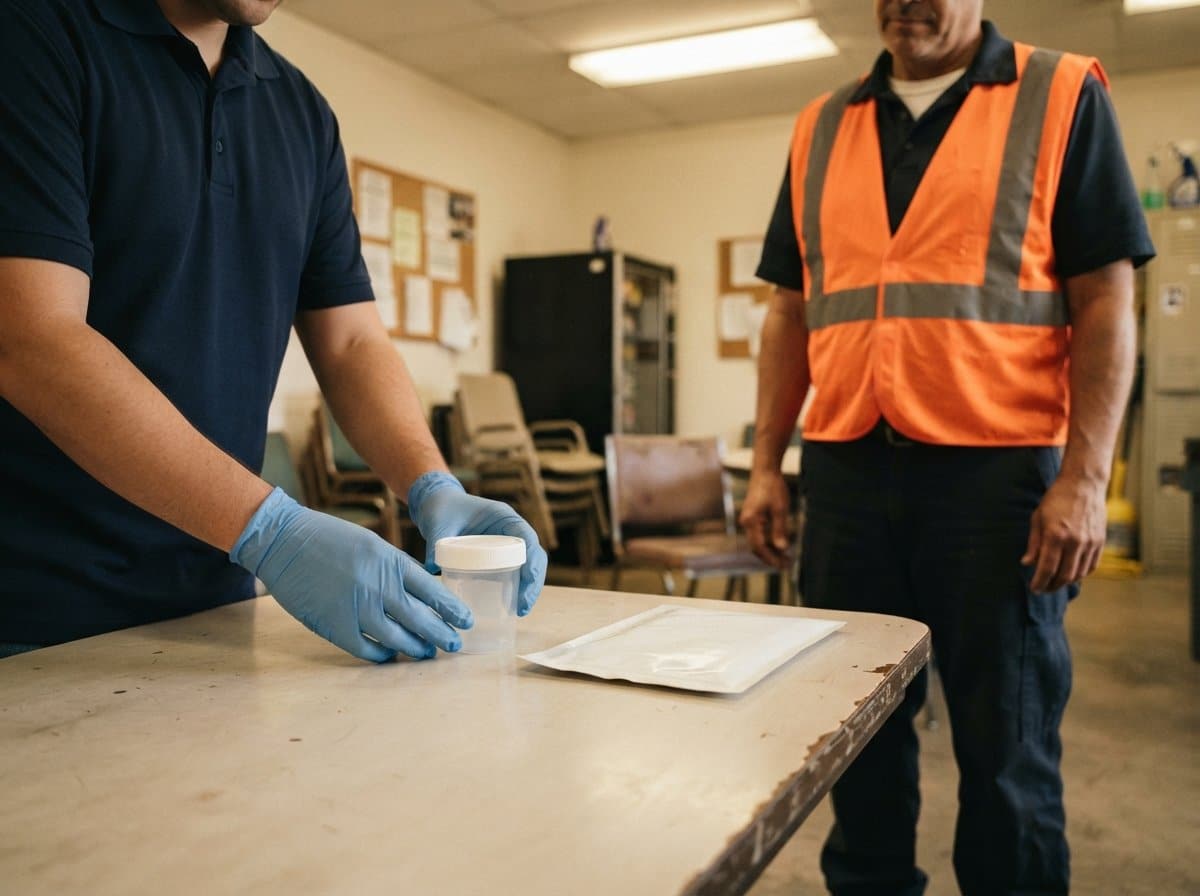
- A controlled collection. A trained collector follows a set procedure, secures the collection area and seals each specimen with tamper-evident tape in front of the donor, which limits the opportunities for substitution or dilution.
- Speed when it counts. Post-accident and reasonable suspicion tests lose value by the hour. A collector who can arrive quickly preserves the evidence your policy depends on.
- Consistency. The same process, the same forms and the same collector standards every time — which is what makes a policy defensible.
Odosek provides on-site and mobile drug testing throughout Columbia and the Midlands — Lexington, Irmo, Cayce, West Columbia, Forest Acres, Blythewood, Chapin, Camden, Sumter and Orangeburg — 24 hours a day by appointment. See our South Carolina service area, or read more on the benefits of onsite and mobile drug testing.
Benefits of using a mobile testing provider for your policy
- Scheduling that fits your operation — early shifts, overnight crews and weekend work in South Carolina can all be tested without special arrangements.
- Professional collection by a trained, qualified collector using chain-of-custody forms.
- Laboratory and MRO coordination. Lab-based specimens are analyzed at a SAMHSA-certified laboratory, and non-negative results are reviewed by a Medical Review Officer — a licensed physician who checks for legitimate prescriptions before a result is reported as positive.
- Confidentiality. Results go only to the designated employer representative, not to supervisors or coworkers.
- Consistent administration across every location and every testing occasion, including both DOT and non-DOT drug testing.
What to include in your workplace drug testing policy
Use the checklist below as a drafting guide, then have your attorney tailor it to your industry and workforce.
- Purpose and scope — why the policy exists and which locations it covers.
- Covered employees — all staff, safety-sensitive roles only, applicants, contractors; separate DOT-covered employees clearly.
- Prohibited conduct and substances — including alcohol and misuse of prescription drugs.
- Testing occasions — which of the six you use, with the specific trigger for each.
- Specimen types and panels — urine, hair, saliva, breath; 5-panel, 10-panel or other.
- Collection procedures — who collects, where, chain of custody, laboratory and MRO review.
- Definition of refusal — not reporting, leaving before completion, tampering, failing to provide a specimen without a medical reason.
- Consequences — for a verified positive, a refusal and a diluted or invalid specimen.
- Confidentiality — who sees results and how records are stored.
- Assistance — employee assistance program (EAP) or rehabilitation resources, if offered.
- Dispute process — how an employee can request a split specimen or retest, and the deadline to do so.
- Acknowledgment form — a signed receipt for every employee.
- Review schedule — at least annually and whenever the law changes.
Pay particular attention to the testing triggers. The matrix below shows how the six occasions differ in ways your policy has to account for.
Communicating the policy to your team
A policy nobody has read protects no one. Roll it out deliberately:
- Give notice before testing begins, so employees have a fair chance to understand the rules.
- Hold a short training session for all staff, and a separate session for supervisors on recognizing and documenting reasonable suspicion.
- Provide a plain-language summary — one page covering when testing happens, what is tested and what a refusal means.
- Explain the dispute process, including how to raise prescription medications with the MRO rather than with a supervisor.
- Collect a signed acknowledgment from every current employee and every new hire, and keep it on file.
How often should employers update their drug testing policy?
Review your policy at least once a year, and immediately whenever a relevant law or regulation changes. Several things move faster than most policies do:
- Cannabis law. South Carolina’s status has held steady, but bills are introduced regularly, and employees who live or work across state lines may be subject to different rules elsewhere.
- New substances. Synthetic cannabinoids, fentanyl and other synthetic opioids, and hemp-derived products are not all detected by older panels. Review with your provider whether your panel still matches the risks you face.
- Federal rule changes. DOT periodically revises Part 40 procedures and the panel of drugs tested; DOT-covered employers must follow the current version.
- Your own experience. Disputes, near-misses and questions from employees are signals that a section needs clearer wording.
Frequently asked questions
What should a workplace drug testing policy include?
At minimum: the purpose and scope, who is covered, prohibited substances and conduct, the testing occasions and their triggers, specimen types and panels, collection and MRO review procedures, what counts as a refusal, consequences, confidentiality, any assistance program, a dispute or retest process, and a signed employee acknowledgment.
Are employers in South Carolina required to have a drug testing policy?
Most private employers are not required by a general state law to drug test. DOT-regulated employers must test covered employees under federal rules, businesses with South Carolina state contracts or grants of $50,000 or more must certify a drug-free workplace, and federal contractors and grantees have drug-free workplace obligations. Ask an employment attorney which rules apply to you.
Can an employee refuse a drug test at work?
An employee can decline, but most policies treat a refusal the same as a positive result, and under DOT rules a refusal carries the same consequences as a verified positive. That is why your policy should define exactly what counts as a refusal.
How does mobile drug testing work for businesses?
You schedule a time, and a trained collector comes to your workplace, verifies each donor’s identity, collects and seals specimens with a chain-of-custody form, and sends lab-based specimens to a SAMHSA-certified laboratory. Non-negative results are reviewed by a Medical Review Officer before they are reported to your designated representative.
What happens if an employee tests positive under a workplace policy?
A lab result is first reviewed by an MRO, who contacts the employee about any legitimate prescription. If the result is verified positive, the employer applies the consequence stated in its policy, which may range from referral to assistance to termination. DOT-covered employees must be removed from safety-sensitive duties and complete the return-to-duty process.
Is random drug testing legal for private employers?
In South Carolina, random testing is generally a policy choice for private employers, and it is required for DOT-covered safety-sensitive employees. Selection must be genuinely random and applied to a defined pool. Have an attorney review your random program before you launch it.
How do I choose the right drug testing method for my workplace policy?
Match the method to the question. Urine is the standard for most programs and required for DOT drug tests; hair shows a longer history for pre-employment; saliva and breath alcohol suit very recent use after an incident; EtG helps monitor alcohol during follow-up. A provider can help you pick panels for your industry.
Odosek also serves metro Atlanta and the Baltimore area, though drug testing services differ by state — see all of our locations or call the local number below.
Put your drug testing policy into practice
Odosek brings pre-employment, random, reasonable suspicion, post-accident and return-to-duty testing to your workplace across Columbia and the Midlands — with SAMHSA-certified laboratory analysis and MRO review. Estimate costs with our drug test pricing calculator, then request a test.
Odosek Mobile DNA & Drug Testing
On-site collection at your office, job site or facility — 24 hours a day, seven days a week, by appointment.
Columbia & the Midlands — full DOT and non-DOT drug testing
Metro Atlanta — instant on-site screens
Baltimore area — call to confirm drug testing availability
Contact our team about setting up a program
Sources and notes
- U.S. DOT drug and alcohol testing procedures: 49 CFR Part 40 (eCFR).
- South Carolina Drug-Free Workplace Act: S.C. Code Title 44, Chapter 107. Workers’ compensation intoxication exclusion: S.C. Code § 42-9-60.
- Medical cannabis bill status: S.53, 2025–2026 session, checked September 2026.
- ADA drug-testing provision: 42 U.S.C. § 12114. Federal contractors and grantees: SAMHSA.
This article is general information about workplace drug testing policies, not legal advice. Laws change and apply differently by industry; consult an employment attorney before adopting or revising a policy.