


On-site legal DNA testing: the short answer
On-site legal DNA testing is a court-admissible DNA test in which a trained, neutral collector comes to you — your home, an attorney’s office, a workplace or a hospital room — verifies everyone’s identity, collects cheek swabs and seals them under a documented chain of custody. The samples are then analyzed at an AABB-accredited laboratory, exactly as they would be after a clinic visit. The location changes; the legal standard does not.
- What makes it legal is the process, not the swab: photo ID, witnessed collection, tamper-evident sealing and an unbroken chain of custody, with analysis at an AABB-accredited laboratory.
- Common uses in South Carolina: child support, custody and visitation, estate and inheritance questions, and other family court matters.
- At-home kits are not court-admissible because nobody independent confirms who provided each sample.
- Results arrive in 2–5 business days after the laboratory receives the samples; legal paternity testing starts at $349.
- Odosek has provided mobile collection across Columbia and the Midlands for 17+ years, is BBB A+ rated and handles records under HIPAA-compliant procedures.
If a family court case, an attorney or a child support caseworker has told you that you need a “legal” DNA test, the first practical question is usually where you have to go to get it. For many people in Columbia, Lexington, Irmo or Sumter, the answer is: nowhere. A mobile collector can come to you and complete the same documented, court-ready collection a lab would.
This guide explains what on-site legal DNA testing is, when you need it, exactly what happens at the appointment and how results reach the court. If you want the broader background first, our guides on what a legal paternity DNA test is and legal vs. non-legal DNA testing cover the fundamentals. This article focuses on the on-site, mobile side of the process.
What is on-site DNA testing for legal purposes?
On-site legal DNA testing is a relationship DNA test whose samples are collected at the client’s location by a neutral third party under chain-of-custody procedures, so the result can be used as evidence. It differs from an at-home or curiosity test in one decisive way: someone independent of the case confirms who gave each sample and documents every hand the sample passes through.
Two things make a DNA result legally usable:
- A documented chain of custody. Identity is verified with photo ID, participants are photographed, consent forms are signed, and samples are sealed in tamper-evident packaging in front of the participants. Our explainer on chain of custody in legal DNA testing goes deeper on each step.
- Analysis at an accredited laboratory. Courts and agencies generally expect relationship testing to be performed by a laboratory accredited by AABB, which assesses laboratories against published relationship-testing standards. Odosek provides the collection; the samples are processed at our AABB-accredited partner laboratory.
Mobile collection keeps the same legal standards as a lab visit because the safeguards are procedural. The ID check, the witnessed swab, the seal and the signed custody form are identical whether they happen in a clinic or at your kitchen table in Forest Acres.
When do you need a legal DNA test?
You need a legal DNA test whenever the result will be relied on by someone other than you — a judge, a government agency, an attorney or an estate. Typical situations include:
- Child support. Establishing or disputing paternity before support is ordered. See our page on DNA tests for child support cases.
- Custody and visitation. A father seeking parental rights, or a party contesting them, in SC Family Court.
- Inheritance and estates. Proving a biological relationship to a deceased or unavailable relative, often through a siblingship, grandparent or avuncular test.
- Birth certificate changes and other family court matters, where an attorney or the court asks for documented results.
In South Carolina, the paternity statute sets a meaningful threshold. Under S.C. Code § 63-17-60, a statistical probability of paternity of 95% or higher creates a rebuttable presumption of paternity, and results that are properly verified to show the chain of custody can be admitted without additional foundation testimony unless a party challenges them by motion in advance of trial. That is exactly why the custody paperwork matters as much as the laboratory result.
Private legal testing is typically used when the parties or their attorneys arrange testing themselves, or when a court order leaves the choice of provider to them.
Odosek does not perform immigration DNA testing. Immigration cases follow a separate process directed by the embassy or agency involved, using an AABB-accredited laboratory selected through that process. If that is your situation, contact us and we will point you to an appropriate provider.
At-home kits bought online or at a pharmacy are not accepted for any of these purposes. The science may be sound, but there is no independent proof of who swabbed whom.
Court-admissible vs. informational DNA tests
Both kinds of test use the same cheek swabs and the same genetic markers. The difference is evidence: an informational (peace-of-mind) test answers a private question, while a court-admissible test answers it in a form a court can rely on. Chain-of-custody documentation is what separates them.
How to choose: if there is any realistic chance the result will end up in front of a judge, a caseworker or an estate, start with a legal paternity DNA test. A private test cannot be converted into a legal one after the fact, so upgrading later means paying for a completely new collection. If you only need a private answer and are certain it will stay private, a peace-of-mind test is the lower-cost option.
How does the on-site legal DNA testing process work?
On-site legal DNA testing follows three steps: you schedule, a trained collector completes a documented collection at your location, and the AABB-accredited laboratory analyzes the samples and releases a report. Convenience changes the where, never the how.
- Schedule the collection.Call or book online and tell us the case type, who needs to be tested, whether there is a court order or case number, and where the collection should happen. Collections are available 24/7 by appointment across the Midlands.
- On-site collection.A trained, qualified collector arrives at the agreed location, verifies each participant’s identity, collects cheek swabs, seals them in tamper-evident packaging and completes the chain-of-custody paperwork with signatures from everyone present. For two people it usually takes about 15 minutes.
- Laboratory analysis and results.The sealed samples are shipped to our AABB-accredited partner laboratory, which confirms the seals are intact, analyzes the samples and releases a report, typically 2–5 business days after receipt.
What happens during sample collection?
Legal DNA collection uses a buccal (cheek) swab: a soft swab rubbed on the inside of the cheek for a few seconds. It is the standard for relationship testing because it is painless, works for newborns and adults alike, and yields plenty of DNA without a needle. Participants should avoid eating, drinking, smoking or chewing gum for about 30 minutes beforehand.
Around the swab itself, the collector follows a fixed protocol:
- Identity verification. Adults present a valid government-issued photo ID. For a child, the parent or legal guardian presents ID and, where available, the child’s birth certificate.
- Photographs and consent. Each participant is photographed for the case file, and consent forms are signed.
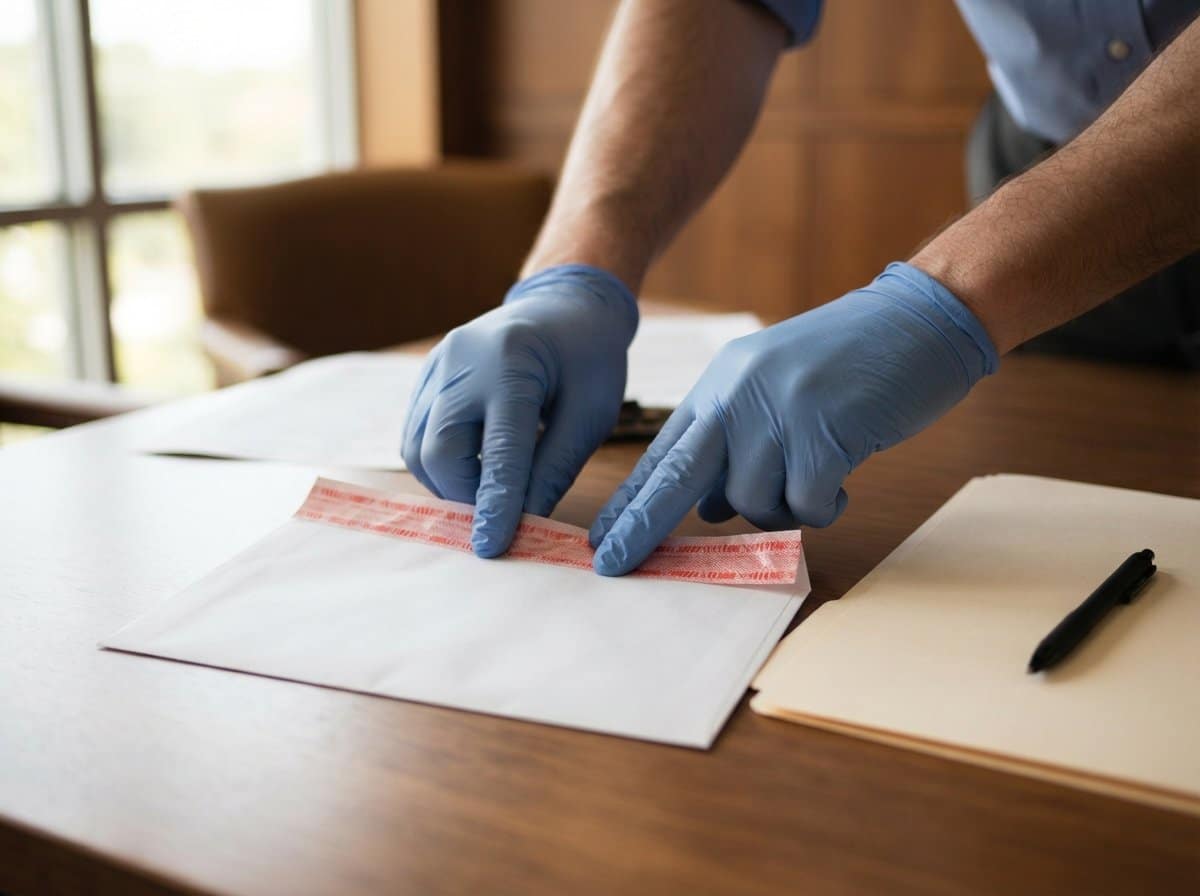
- Sealing and labeling. Swabs are placed in labeled envelopes and closed with tamper-evident seals in front of the participants, who initial the seals.
- Custody form. The chain-of-custody form records who collected what, when and where, and the sealed package goes directly to the laboratory.
The collector is neutral. They do not represent either party, do not discuss the case and do not interpret results. That independence is what allows a court to trust a sample collected in a living room in Blythewood as much as one collected in a clinic.
How are legal DNA test results delivered?
Legal DNA results are typically ready 2–5 business days after the laboratory receives the samples. Our guide on how long DNA test results take breaks down each stage of that clock.
The result is issued as an official laboratory report listing the participants, the genetic markers tested, the combined relationship index and the probability of relationship. It is released to the parties and recipients named on the case paperwork — for example the tested parties, their attorneys or the court, as your order or case directs. If the report must go to a specific court, agency or attorney, say so when you book so it is routed correctly. Nobody outside the case receives it.
Why choose a mobile on-site service for legal DNA testing?
A mobile on-site service delivers the same court-admissible result as a lab visit while removing travel, waiting rooms and schedule conflicts. For many families that is the difference between getting tested this week and putting it off for a month.
- No travel. The collector comes to your home, your office, your attorney’s office or a hospital room.
- Flexible scheduling. Collections are available 24/7 by appointment, including evenings and weekends.
- Less stress. A familiar setting is easier on children and on adults dealing with a difficult family situation.
- Separate collections when needed. When parties cannot or should not be in the same room, each can be collected separately with the chain of custody maintained.
- Same standards. Samples are processed at our AABB-accredited partner laboratory, and the report is the same as a clinic-collected one.
Odosek serves Columbia and the Midlands, including Columbia, Lexington, Irmo, Cayce, West Columbia, Forest Acres, Blythewood, Chapin, Elgin, Camden, Sumter and Orangeburg, across Richland and Lexington counties and beyond. See all of our South Carolina locations, or read about court-ordered DNA testing in Columbia, SC.
What types of legal DNA tests are available?
Most legal cases are paternity tests, but when the alleged father is unavailable or deceased, other relatives can establish the relationship indirectly. All of these can be collected on site with a full chain of custody.
| Test | Who is tested | Typical legal use | Price |
|---|---|---|---|
| Legal paternity | Alleged father and child (mother recommended) | Child support, custody, visitation, birth certificate changes | From $349 |
| Siblingship | Two or more alleged siblings | Estates and inheritance; paternity questions when the father is unavailable | From $399 |
| Grandparent | Alleged grandparent(s) and child | Paternity when the alleged father is deceased or unavailable | From $399 |
| Avuncular | Alleged aunt or uncle and child | Indirect paternity through the alleged father’s full sibling | From $399 |
Which fits? If the alleged father can be tested, paternity is the most direct and conclusive option. If he cannot, a grandparent test is usually the strongest alternative, followed by an avuncular test or a siblingship test. Indirect tests produce statistical likelihoods rather than near-certain answers, so including the child’s mother usually strengthens the result. Your attorney can confirm which test your court will accept.
How is confidentiality maintained in legal DNA testing?
Legal DNA testing balances two obligations: protecting your privacy and getting the result to the people legally entitled to it. Personal information is handled under HIPAA-compliant procedures, samples travel sealed under a case number, and reports are released only to the parties and recipients named on the case paperwork.
On-site collection adds a practical layer of discretion. There is no public waiting room, and the collector arrives by appointment at a location you choose. What confidentiality cannot do is keep a result from a court that ordered the test — once a test is part of a legal case, the court, the parties and their attorneys will see it. If you are unsure who will receive your report, ask before the collection.
Need a court-admissible DNA test in the Midlands?
A trained collector can come to your home, office or attorney’s office anywhere in Columbia and the Midlands, 24/7 by appointment.
Frequently asked questions
What makes a DNA test result legally admissible in court?
Two things: a documented chain of custody and analysis at an accredited laboratory. A neutral collector verifies each participant’s photo ID, photographs participants, collects the samples and seals them in tamper-evident packaging with signed custody forms, and the samples are analyzed at an AABB-accredited laboratory. In South Carolina, S.C. Code § 63-17-60 allows properly verified results to be admitted, and a probability of paternity of 95% or higher creates a rebuttable presumption of paternity. Your attorney can confirm what your specific court requires.
Can a mobile DNA test be used for immigration or custody cases?
For custody, yes. A mobile legal DNA test with full chain of custody is suitable for custody, visitation and child support matters in SC Family Court. For immigration, no: Odosek does not perform immigration DNA testing. Immigration cases follow a separate embassy- or agency-directed process with an AABB-accredited laboratory chosen through that process, and we can point you to an appropriate provider.
How is the chain of custody maintained during on-site DNA collection?
The collector checks and records each participant’s photo ID, takes photographs, collects cheek swabs, and seals them in labeled tamper-evident envelopes in front of the participants, who sign the chain-of-custody form. The sealed package goes directly to the laboratory, which confirms the seals are intact on arrival. Every hand-off is documented, whether the collection happens at a clinic or at your home.
How long does it take to receive legal DNA test results?
Legal DNA results are typically ready 2 to 5 business days after the laboratory receives the samples. Collection itself can often be scheduled quickly because the collector comes to you. If you have a hearing date, mention it when you book.
Do both parties need to be present for a legal DNA test?
Not necessarily. Participants can be collected at separate appointments or separate locations, as long as each collection is performed by a neutral collector with ID verification and chain-of-custody documentation. The laboratory matches the samples by case number. Separate collections can be useful when parties live in different cities or should not meet; tell us at booking so we can coordinate.
Is on-site legal DNA testing available in Georgia, South Carolina, and Maryland?
Yes. Odosek’s home base is Columbia, South Carolina, with mobile legal DNA collection across the Midlands, including Lexington, Irmo, Cayce, West Columbia, Forest Acres, Blythewood, Chapin, Camden, Sumter and Orangeburg; call (803) 766-0036. Odosek also serves metro Atlanta and the Baltimore area — see all of our locations.
What is the difference between a legal paternity test and a home paternity test?
The lab science can be the same; the difference is documentation. A legal paternity test is collected by a neutral third party with ID verification and a chain of custody, so the result can be used in court or by an agency. A home test is self-collected with no proof of who provided each sample, so it is for personal knowledge only and is not accepted by courts.
Odosek Mobile DNA & Drug Testing
Mobile collection at your home, office, hospital or attorney’s office — 24 hours a day, seven days a week.
Columbia & the Midlands
Metro Atlanta & northeast GA
Baltimore & surrounding counties
Family law collections with court-ready documentation
Sources and notes
- South Carolina Code of Laws, Title 63, Chapter 17 — § 63-17-60 (95% probability presumption; chain-of-custody verification).
- AABB — accreditation program and accredited facilities directory. Odosek provides mobile collection and chain-of-custody services; samples are processed at an AABB-accredited partner laboratory.
This article is general information, not legal advice. Requirements vary by case, and some court orders name a specific facility or procedure — confirm with your attorney or the court before booking.