
The short answer
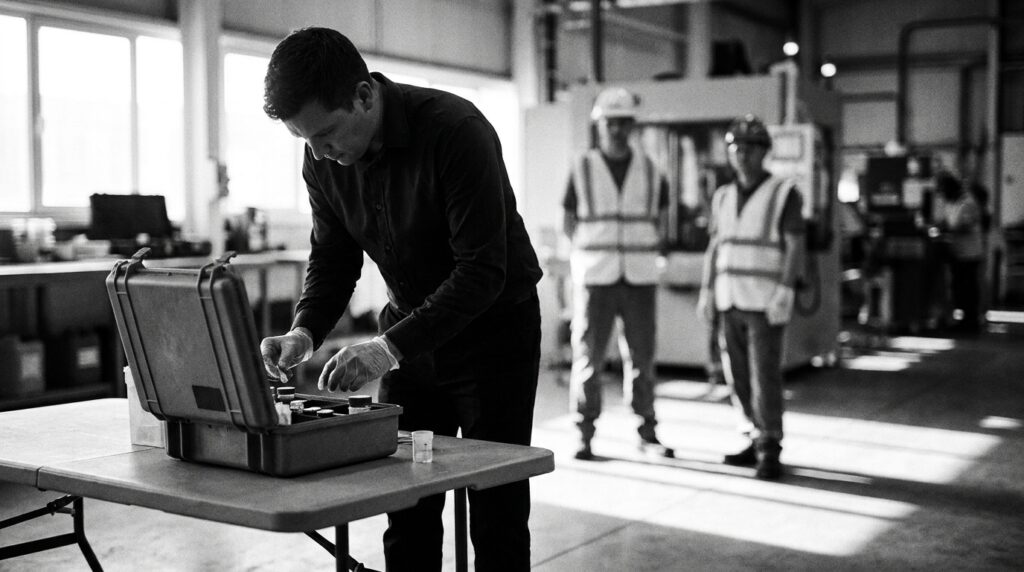
Onsite drug testing sends a trained, qualified collector to your workplace, job site or home instead of sending people to a clinic. The specimen is collected under the same chain-of-custody rules a fixed lab uses, sealed in front of the donor, and shipped to a SAMHSA-certified laboratory. Results come back in roughly 24 to 72 hours and carry the same legal weight as a clinic collection.
- Time: 15–30 minutes on site per person, versus 2–4 hours for a clinic round trip.
- Cost: usually cheaper per person once you are testing five or more people in one visit.
- Integrity: nobody travels unsupervised between the notification and the collection.
- Speed: same-day and next-day appointments, including evenings and weekends.
Onsite drug testing — also called mobile drug testing or on-site drug screening — has changed how employers, courts and individuals handle substance screening. Rather than sending an employee across town and losing most of a shift, a collector comes to you with everything the collection requires. Whether you run a construction crew, manage a trucking fleet, or need a court-ordered test completed inside a deadline, the logistics stop being your problem.
This guide covers what onsite testing actually is, where the savings come from, how accuracy and legal defensibility are preserved outside a clinic, and when it is — and is not — the right call.
What is onsite drug testing?
Onsite drug testing is a professional specimen collection performed at your location by a certified collector who travels to you. The collector brings the collection kits, the temperature-verification strips, the tamper-evident seals and the federal chain-of-custody form. The donor never enters a clinic.
The important thing to understand is what does not change. The collection procedure, the identity verification, the specimen-integrity checks and the documentation are the same ones used in a fixed collection site, because they are dictated by regulation and laboratory protocol — not by the room you happen to be standing in. What changes is only the address.
At Odosek Lab Solutions, specimens are processed at a SAMHSA-certified laboratory. SAMHSA certification is the federal standard for workplace drug testing laboratories: the lab is subject to ongoing proficiency testing and inspection by the Department of Health and Human Services, and it is the certification the Department of Transportation requires for regulated testing. Any non-negative result is reviewed by a Medical Review Officer — a licensed physician who contacts the donor privately before a result is finalised.
Different test types answer to different bodies, and the distinction matters if anyone ever challenges your result. Workplace and DOT drug testing is governed by SAMHSA certification of the laboratory. Relationship and paternity DNA testing is governed by AABB accreditation. Odosek is a mobile collection provider — the certifications and accreditations belong to the laboratories that process the specimens, and Odosek itself is HIPAA compliant and BBB A+ rated. The practical question to ask any provider is simply which laboratory processes the specimen, and whether that laboratory is SAMHSA-certified.
Benefits of onsite drug testing for employers
You stop paying for travel time
A clinic-based drug test is rarely a 20-minute errand. Between leaving the site, driving, waiting in a queue behind unscheduled walk-ins, completing the collection and driving back, most employers lose two to four hours of paid time per employee. The test itself is the smallest part of it.
Onsite testing collapses that to the collection alone. A collector arrives during a shift change or a scheduled window, works through the list, and each person is back on the floor in 15 to 30 minutes. On a 20-person testing cycle the arithmetic is stark, and it is the single clearest argument for the model.
Lower cost per person once you test in volume
For a single individual test, onsite collection often costs about the same as a clinic visit, and sometimes slightly more because of the travel component. The economics invert as soon as more than one person is being tested. When a collector handles five, ten or forty people in one visit, the trip cost is spread across all of them and the per-person price drops.
The larger saving is usually the one that never appears on the invoice: wages paid for travel, mileage reimbursement, supervisors covering absent staff, and the administrative hours spent coordinating who reports where. You can model the direct portion using the drug test price calculator before committing to a program.
The stakes are worth stating plainly. Research by NORC at the University of Chicago with the National Safety Council puts the cost of an employee with an untreated substance use disorder at roughly $8,817 per year in lost productivity, absenteeism, turnover and health care, and estimates employers save more than $8,500 per employee who reaches recovery. A testing program is not overhead; it is the mechanism that surfaces the problem early enough to act on.
Nobody travels unsupervised
This benefit gets overlooked and it is arguably the most important one for safety-sensitive work. When you notify an employee that they have been selected and then send them across town alone, you have handed them an unsupervised gap between notification and collection. That gap is where substitution and adulteration attempts happen.
Onsite collection removes it. The collector is already on site when the notification happens, which is why random workplace drug testing and reasonable suspicion testing are both markedly stronger programs when run onsite. It matters most in post-accident drug testing, where the clock is running and every hour of delay degrades the evidence.
One standard across every location
Companies operating in more than one city run into a quiet compliance problem: different clinics use different forms, different procedures and different result formats. That inconsistency is invisible until a result is challenged, at which point the gaps in documentation become the whole argument.
A single mobile provider applies one protocol, one chain-of-custody form and one reporting standard everywhere. Odosek serves South Carolina, Georgia and Maryland, so a crew screened at a job site outside Atlanta and a new hire onboarded in Baltimore go through an identical process, with records that live in one place when an audit arrives.
Benefits for individuals and court-ordered testing
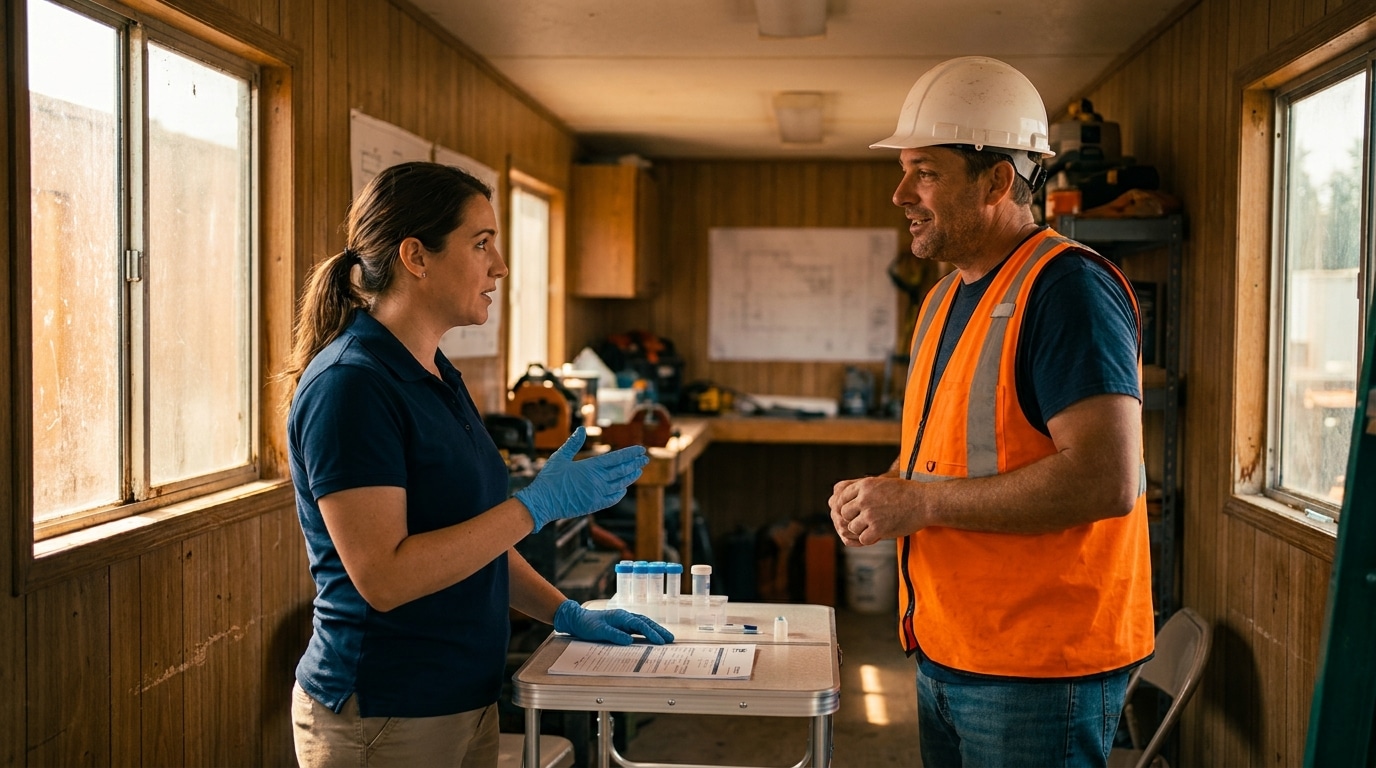
Privacy you actually control
For a lot of people the hardest part of a drug test is the waiting room. Being recognised by a neighbour or a coworker in a testing facility adds a layer of stress to a situation that is already uncomfortable, and it is a genuine deterrent to people who need to complete a test on schedule.
Onsite collection removes that exposure. The test happens somewhere you chose. All personal and medical information is handled under HIPAA privacy standards, results are released only to the recipients you authorise at the time of scheduling, and nothing is shared beyond that list without your consent.
Scheduling that fits real life
Same-day and next-day appointments are available for urgent situations, and evening and weekend availability means you do not have to burn a vacation day to stay compliant. For people managing court-ordered drug testing or custody-related monitoring, home-based collection removes two of the most common reasons people miss a required test: no transportation, and no way to get time off work.
One caution worth stating: always confirm the specific collection requirements in your order or agreement before booking. Some courts, probation offices and treatment programs specify a named facility, an observed collection, or a particular panel. Mobile collection satisfies most orders, but the order governs.
How onsite testing stays accurate and defensible
Defensibility rests on three things: a correct collection, an unbroken chain of custody, and a certified laboratory running validated methods. Onsite testing satisfies all three when the provider is qualified — and fails all three when it is not, which is why the provider matters more than the location.
Confirmation testing prevents false positives
An initial immunoassay screen is sensitive but not specific — it flags a class of compounds rather than an individual substance. That is why any non-negative screen is sent for confirmation by gas chromatography–mass spectrometry or liquid chromatography–tandem mass spectrometry, which identifies the specific molecule and quantifies it.
Only after confirmation does a Medical Review Officer review the result and contact the donor privately to ask about legitimate prescriptions. A verified prescription turns a laboratory positive into a reported negative. This is the step that protects employees taking prescribed medication, and skipping it is one of the fastest ways for an employer to create liability.
Specimen integrity in transit
Temperature is checked within four minutes of collection and recorded on the form. Specimens are packaged in sealed transport containers, held in appropriate conditions, and delivered to the laboratory inside the required timeframe. Handled properly, transport is not a weak point — it is simply another documented step.
Industries that benefit most from onsite testing
Construction and manufacturing
Heavy machinery, working at height and moving equipment make impairment a life-safety issue rather than a policy issue. Onsite collection lets a large crew be screened at a remote or active job site without shutting the site down or busing workers to a clinic.
Pre-employment drug testing can be completed at the site during onboarding, which keeps start dates from slipping. Random programs become genuinely random, because a collector can arrive with little advance notice and test people where they already are.
Transportation and logistics
Commercial drivers under Federal Motor Carrier Safety Administration rules are subject to pre-employment, random, post-accident, reasonable-suspicion, return-to-duty and follow-up testing. Non-compliance carries fines and puts operating authority at risk, so the programs are not optional and the deadlines are not flexible.
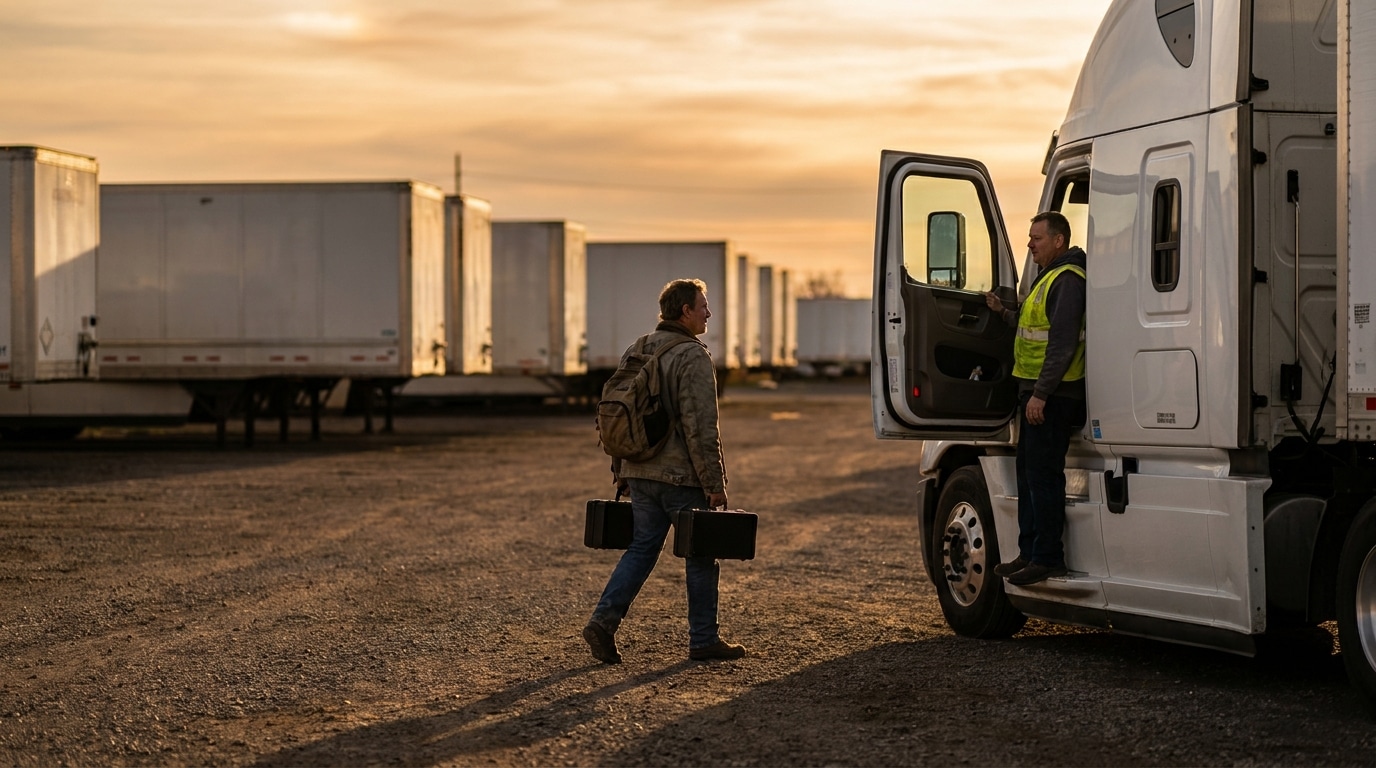
The post-accident windows are where mobile collection earns its keep. Under 49 CFR 382.303, an alcohol test should be administered within two hours and attempts must stop at eight hours; a controlled substances test must be collected within 32 hours. If either window closes, the employer has to document why. A collector who can meet a driver at a terminal, a depot or the roadside is often the difference between a compliant file and an explanation. Odosek handles both DOT drug testing and non-DOT drug testing, including return-to-duty testing after a violation.
Healthcare and education
Clinical and school schedules are difficult to interrupt, and a clinic visit usually means someone else covering patients or a classroom. Onsite collection at a hospital, clinic, school or district office during a low-impact window avoids that entirely.
Student-athlete programs are a natural fit as well — a single collector can screen a full roster at the practice facility in one visit, rather than coordinating dozens of individual appointments across a season.
Onsite vs. clinic drug testing: what actually differs
| Factor | Onsite / mobile testing | Clinic-based testing |
|---|---|---|
| Location | Your workplace, job site, or home | Fixed collection site during posted hours |
| Scheduling | Same-day and next-day; evenings and weekends available | Limited to clinic hours and open appointment slots |
| Employee time lost | 15–30 minutes, on site | 2–4 hours including travel and waiting |
| Cost, single test | Comparable, sometimes slightly higher | Comparable |
| Cost, 5+ people | Lower per person; trip cost is shared | Higher once wages and travel are counted |
| Unsupervised travel gap | None — collector is already on site | Present between notification and collection |
| Privacy | Location of your choosing, no shared waiting room | Shared waiting room |
| Chain of custody | Identical federal form and procedure | Identical federal form and procedure |
| Laboratory | SAMHSA-certified, with MRO review | SAMHSA-certified, with MRO review |
| Results timeline | 24–72 hours (longer if confirmation is needed) | 24–72 hours (longer if confirmation is needed) |
| Legal standing | Same as a clinic collection | Same as an onsite collection |
The row that matters most is the one where nothing differs. Onsite testing does not trade accuracy or legal standing for convenience — the laboratory, the panel, the cutoffs and the paperwork are the same. What it removes is travel, waiting and the coordination burden. The break-even point is roughly five people per visit; above that the case is straightforward, and below it the deciding factor is usually urgency or privacy rather than cost.
What types of drug tests can be done onsite?
Nearly every common screening method can be collected at your location. The right one depends on what you need to know — recent impairment, or a longer history of use — because the specimen type, not the panel size, sets the detection window.
- Urine drug screens — the default for workplace and DOT programs, available as 5-panel, 7-panel, 10-panel and 12-panel configurations. The federal DOT panel is a 5-panel.
- Hair follicle testing — roughly a 90-day history, useful for pre-employment screening and legal matters where a pattern of use is the question. It will not detect use in the last few days.
- Oral fluid testing — detects recent use, is minimally invasive, and can be collected under direct observation without privacy concerns. Increasingly used for post-accident and reasonable-suspicion situations.
- Breath alcohol testing — immediate results for current alcohol concentration, and the standard for DOT-regulated alcohol testing.
How onsite drug testing works, step by step
- Schedule your windowYou pick the location, date and time — a shift change, a break period, an onboarding appointment, or an evening at home. Tell the scheduler the panel you need and who should receive the results.
- The collector comes to youA certified collector arrives with the kits, seals, temperature strips and chain-of-custody forms. Nothing needs to be prepared on your end beyond a private, reasonably clean space. Each collection takes 15 to 30 minutes.
- Lab analysis and MRO reviewSealed specimens go to a SAMHSA-certified laboratory. Negatives are typically reported in 24 to 48 hours. Non-negatives go through GC-MS confirmation and Medical Review Officer review, which adds time but is what makes the result stand up.
When should you use onsite drug testing?
Onsite collection is the stronger choice in these situations:
- Testing five or more people at once — the cost and time case is unambiguous above this threshold.
- Post-accident testing — the DOT windows are tight and travel eats them.
- Random and reasonable-suspicion programs — removing the unsupervised travel gap materially strengthens the program.
- Remote or active job sites — where sending people to a clinic means stopping work.
- Court-ordered and custody-related monitoring — where transportation or privacy is a barrier to compliance.
- Onboarding cycles — testing new hires during their existing orientation visit rather than scheduling a second trip.
It is the weaker choice when a court order or program names a specific facility, when an observed collection is required and you cannot provide a suitable private space, or when you need a single individual test and the nearest clinic is genuinely convenient. An honest provider will tell you when a clinic is the better answer.
How confidentiality is protected
Confidentiality is where a testing program most often creates exposure for the organisation running it, so it is worth being specific about the controls rather than gesturing at them.
- Documented handling. The chain-of-custody record shows who held the specimen, when, and under what conditions, from collection through to reporting. It protects the donor as much as the employer.
- HIPAA-compliant information handling. Personal and medical information is handled under HIPAA privacy standards throughout.
- A named recipient list. Results are released only to the recipients confirmed at scheduling — not to supervisors, coworkers or anyone else who asks.
- Encrypted delivery. Reports are delivered through an encrypted digital system rather than by open email or fax.
- MRO privacy. When a Medical Review Officer contacts a donor about a prescription, that conversation stays between the donor and the physician. The employer receives a verified result, not a medical history.
Onsite drug testing near you: South Carolina, Georgia and Maryland
Odosek Lab Solutions is a mobile provider — there is no waiting room, because the collector travels to you. Coverage spans three states, with live scheduling available 24/7 and same-day appointments in most of the service area.
Book an onsite collection
Call the number for your state. Live representatives are available 24 hours a day, seven days a week.
Columbia and the Midlands, Lexington, Sumter, Orangeburg, Aiken, Newberry, Florence, Camden, Irmo, Chapin, Cayce and West Columbia.
Metro Atlanta and the northeast corridor: Lawrenceville, Duluth, Loganville, Snellville, Norcross, Buford, Roswell, Sandy Springs, Decatur, Conyers, Monroe and Winder.
Baltimore metro and the I-95 corridor: Towson, Columbia, Ellicott City, Glen Burnie, Annapolis, Bel Air, Silver Spring, Rockville, Bowie, Catonsville and Dundalk.
If your city is not listed, it is still worth calling — mobile coverage extends well beyond the named towns. The full list is on the service areas page, and South Carolina coverage is detailed on the Columbia, SC and Midlands locations page.
Get an onsite drug test scheduled
Tell us the panel, the number of people and the window that works. Most requests are confirmed the same day, and bulk pricing applies from five people up.
Frequently asked questions
How long does onsite drug testing take from start to finish?
The collection itself takes 15 to 30 minutes per person depending on the specimen type. Once the sealed specimen reaches the laboratory, negative results are typically reported within 24 to 48 hours, and most results are complete within 72 hours. Non-negative screens take longer because they go through GC-MS confirmation and Medical Review Officer review before anything is reported.
Are onsite drug test results legally admissible?
Yes. Admissibility depends on the chain of custody and the certification of the laboratory, not on where the specimen was collected. An onsite collection performed by a certified collector using the federal chain-of-custody form, processed at a SAMHSA-certified laboratory and reviewed by a Medical Review Officer, meets the same evidentiary standard as a collection performed inside a clinic. If a specific court order names a facility or requires an observed collection, follow the order — it governs.
How much does onsite drug testing cost compared to a clinic?
For a single test, onsite collection is usually comparable to a clinic visit and can be slightly higher because of the travel component. From roughly five people per visit upward, onsite becomes the cheaper option once you count employee wages for travel time, mileage, and the administrative hours spent coordinating appointments. Bulk pricing is available, and the drug test price calculator gives a direct estimate.
How long does it take to detect drugs in urine?
A urine screen generally detects most substances for one to four days after use. Heavy or chronic cannabis use can remain detectable for up to about 30 days. Cocaine and opiates typically clear within two to four days, while some benzodiazepines persist longer. If you need to look further back than a month, hair testing covers roughly 90 days; if you need to know about the last few hours, oral fluid is the better specimen.
Can an onsite drug test detect prescription medications?
Yes. Depending on the panel, testing detects classes that include prescription opioids, benzodiazepines and amphetamines. This is exactly why Medical Review Officer review exists: the MRO contacts the donor privately to confirm a valid prescription before any result is finalised, and a verified prescription is reported to the employer as a negative. Employees taking legally prescribed medication are protected by that step.
How quickly can an onsite drug test be scheduled?
Same-day and next-day appointments are available across most of the South Carolina, Georgia and Maryland service area. Urgent situations — post-accident and reasonable-suspicion testing in particular — are prioritised, because DOT post-accident collections have to happen inside an 8-hour window for alcohol and a 32-hour window for controlled substances.
What happens if an employee refuses an onsite drug test?
Under DOT rules and most employer policies, a refusal is treated the same as a positive result, and that can mean removal from a safety-sensitive position, discipline or termination. Refusal includes leaving before the collection is complete and failing to provide an adequate specimen without a valid medical explanation. Employers should have a written policy stating the consequences of refusal before any testing program begins — applying an unwritten rule after the fact is where disputes start.
Do onsite drug testing services operate on weekends and holidays?
Yes. Odosek schedules evenings, weekends and selected holidays, which matters for operations that run around the clock and for post-accident testing that cannot wait for Monday. Call the number for your state to confirm availability for a specific date and location.
The bottom line
Onsite drug testing is not a convenience-for-accuracy trade. The laboratory, the panel, the cutoffs, the chain-of-custody form and the Medical Review Officer review are identical to a clinic collection — what disappears is the travel, the waiting room and the unsupervised gap between notification and collection. For any employer testing more than a handful of people, and for anyone facing a deadline or a privacy concern, that makes it the more practical option.
If you are weighing a testing program, the useful next step is a cost comparison against what your current process actually costs in paid hours. Related reading: why mobile lab testing services work.
Sources and references
- Post-accident testing time windows: 49 CFR § 382.303, Federal Motor Carrier Safety Administration.
- Employer cost of untreated substance use disorder: NORC at the University of Chicago and the National Safety Council.
- Laboratory certification for workplace testing: SAMHSA certified laboratory list, Substance Abuse and Mental Health Services Administration.
This article is general information about drug testing procedures and is not legal advice. Employers should have workplace testing policies reviewed by counsel, and individuals under a court order should follow the terms of that order.