
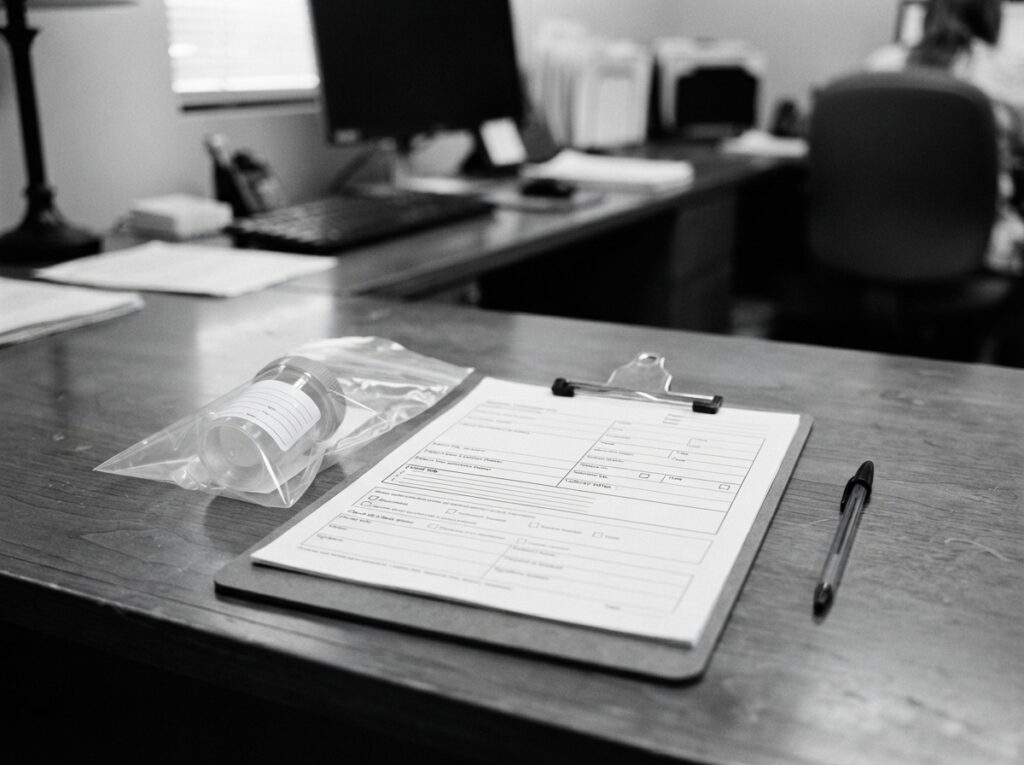
Pre-employment drug testing protects employers from safety and liability risk, and it’s a routine, predictable step for job seekers who know what to expect. Here’s what a pre-employment drug test actually screens for, how the process works for both sides, and what the law does and doesn’t require.
Key takeaways
- Most pre-employment panels screen for 5–10 substances: THC, cocaine, opiates, amphetamines, and PCP are standard.
- Samples are processed at a SAMHSA-certified laboratory with Medical Review Officer (MRO) review — the correct credential for drug testing (a different standard than AABB, which applies to DNA relationship testing).
- Job seekers should disclose any prescription medications to the MRO if their result is flagged — this is routine and confidential.
- Mobile and onsite collection is available, so employers don’t need to send candidates to a clinic.
- State law on marijuana varies; federally regulated (DOT) positions follow federal rules regardless of state law.
Why employers require pre-employment drug testing
Employers test for safety (especially in safety-sensitive roles — driving, operating machinery, healthcare), to reduce liability exposure, and because some contracts or industries (transportation, federal contracting) require it. A documented, consistently applied testing policy also protects the employer from discrimination claims — testing everyone in a role the same way, rather than singling people out, is the standard practice.
What does a pre-employment drug test look for?
| Panel | Substances typically screened |
|---|---|
| 5-panel (most common) | THC (marijuana), cocaine, opiates, amphetamines, PCP |
| 10-panel (expanded) | 5-panel plus barbiturates, benzodiazepines, methadone, propoxyphene, quaaludes |
| DOT panel | Federally mandated substances for safety-sensitive transportation roles per 49 CFR Part 40 |
Detection windows by test method
How the process works for employers
- Set your policy.Decide which roles require testing and at what stage (offer-contingent is standard), and apply it consistently.
- Schedule collection.Onsite or mobile collection means candidates test at your workplace instead of a clinic — see our onsite drug testing guide for how that works.
- Lab analysis.Samples are processed at a SAMHSA-certified laboratory.
- MRO review.A Medical Review Officer reviews any non-negative result and contacts the candidate confidentially about prescription medications before a final result is reported.
- Results delivered.Typically within 24–72 hours for standard panels.

What job seekers should know
- Disclose prescriptions to the MRO, not the employer. If your result is flagged, the MRO will contact you privately to review any legitimate prescriptions before the employer ever sees a positive result.
- Dilution and tampering are treated as separate issues from a positive result — drink normally, don’t over-hydrate specifically to “pass,” which can itself flag a sample as diluted.
- State marijuana laws don’t override an employer’s drug-free workplace policy in most states, and federal DOT rules apply regardless of state law for safety-sensitive positions.
- Ask about the panel and timeline before your appointment so you know what to expect.
Legal considerations employers should know
Testing policies should be applied consistently and documented in writing. For DOT-regulated positions, post-accident testing has strict federal windows: alcohol testing within 2 hours (efforts should cease at 8 hours), and controlled-substance testing within 32 hours, per 49 CFR Part 40. Beyond DOT-regulated roles, state law on marijuana and other substances varies significantly — check your state’s current rules before finalizing a policy.
Onsite testing vs. sending candidates to a clinic
A collector coming to your workplace keeps candidates from losing two to four hours traveling to and waiting at a clinic, with the same SAMHSA-certified lab processing and chain of custody. See our full breakdown in What Are the Benefits of Onsite and Mobile Drug Testing?
Frequently asked questions
What does a standard pre-employment drug test look for?
Most standard panels screen for THC, cocaine, opiates, amphetamines, and PCP; expanded panels add substances like benzodiazepines and barbiturates.
How long does it take to get pre-employment drug test results?
Typically 24–72 hours, though MRO review of a flagged result can add time.
Do I have to disclose my prescriptions?
Only if your result is flagged — a Medical Review Officer will contact you privately and confidentially to review any legitimate prescriptions before a final result is reported to the employer.
Can an employer test at the workplace instead of a clinic?
Yes — onsite and mobile collection brings a certified collector to the workplace, using the same SAMHSA-certified lab and chain of custody as a clinic visit.
Is AABB accreditation relevant to drug testing?
No — AABB accredits DNA relationship-testing laboratories. Drug testing labs are certified by SAMHSA, a different federal standard. See our guide to AABB accreditation for the DNA-testing side.
Schedule employment drug testing
Onsite and mobile collection for employers across South Carolina, Georgia, and Maryland — SAMHSA-certified lab processing, 24/7 by appointment.
Odosek Mobile DNA & Drug Testing
Mobile collection at your home, office, hospital or attorney’s office — 24 hours a day, seven days a week.
Columbia & the Midlands
Metro Atlanta & northeast GA
Baltimore & surrounding counties
Set up onsite testing for your workplace