
What does a DOT drug test include? The short answer
A DOT drug test is a federally regulated urine test that screens for five drug classes: marijuana, cocaine, amphetamines, opioids and PCP. It follows the step-by-step rules in 49 CFR Part 40, from the Federal Custody and Control Form at collection to a SAMHSA-certified laboratory and a Medical Review Officer (MRO) who verifies the result before the employer sees it.
- The panel is fixed by federal rule. Employers cannot add or remove drugs from a DOT test.
- Every specimen is split into two sealed bottles (Bottle A and Bottle B) so a positive can be retested.
- DOT drug tests are lab-based. Rapid or instant cups are never used for a DOT result.
- Negative results typically reach the employer in 24 to 72 hours. Non-negatives take longer because they need confirmation and an MRO interview.
- DOT alcohol testing is separate. It uses an evidentiary breath testing device (EBT), and 0.04 or higher is a violation.
If you run a fleet with CDL drivers in Columbia, SC, the DOT drug test is neither optional nor flexible. This guide covers what is tested, how the specimen is handled and what you are responsible for as the employer.
What does a DOT drug test test for?
People call it a “DOT 5-panel” because the federal rule covers five drug classes. Inside those five classes, the laboratory looks for specific drugs and metabolites. As of this writing, the current text of 49 CFR 40.85 lists the following.
The five DOT drug classes
- Marijuana metabolites: THCA, the metabolite the body produces after THC use.
- Cocaine metabolite: benzoylecgonine.
- Amphetamines: amphetamine, methamphetamine, MDMA (ecstasy) and MDA.
- Opioids: codeine, morphine, 6-acetylmorphine (6-AM, the heroin-specific metabolite), hydrocodone, hydromorphone, oxycodone and oxymorphone.
- Phencyclidine: PCP.
Is fentanyl part of the DOT drug test?
Not yet, as of this writing. The current eCFR text of 49 CFR 40.85 does not include fentanyl. In September 2025 DOT proposed adding fentanyl and its metabolite norfentanyl to the DOT panels, after HHS added them to the federal workplace panel. Until a final rule takes effect, employers may not add fentanyl to a DOT test, so check the ODAPC website for the current status. Fentanyl screening for other workers belongs in a separate non-DOT test.
DOT drug test cutoff levels
A result is only reported as positive if it meets or exceeds the federal cutoff on both the initial screen and the confirmation test. These are the urine cutoffs in 49 CFR 40.85 as of this writing, in nanograms per milliliter (ng/mL).
| Drug or metabolite | Initial test cutoff | Confirmation cutoff |
|---|---|---|
| Marijuana metabolites (THCA) | 50 ng/mL | 15 ng/mL |
| Cocaine metabolite (benzoylecgonine) | 150 ng/mL | 100 ng/mL |
| Codeine / morphine | 2,000 ng/mL | 2,000 ng/mL each |
| Hydrocodone / hydromorphone | 300 ng/mL | 100 ng/mL each |
| Oxycodone / oxymorphone | 100 ng/mL | 100 ng/mL each |
| 6-acetylmorphine (heroin) | 10 ng/mL | 10 ng/mL |
| Phencyclidine (PCP) | 25 ng/mL | 25 ng/mL |
| Amphetamine / methamphetamine | 500 ng/mL | 250 ng/mL each |
| MDMA / MDA | 500 ng/mL | 250 ng/mL each |
Who has to take a DOT drug test?
DOT testing applies to safety-sensitive employees under six federal agencies. Each agency defines who is covered, and all use the Part 40 procedures.
- FMCSA: commercial driver’s license holders, including owner-operators.
- FAA: pilots, flight attendants, aircraft mechanics, air traffic controllers.
- FRA: railroad train crews, dispatchers and signal workers.
- FTA: public transit operators, mechanics and dispatchers.
- PHMSA: pipeline operations, maintenance and emergency-response workers.
- USCG: commercial vessel crew (the Coast Guard follows Part 40 too).
In the Midlands, the largest group is FMCSA-regulated CDL drivers: freight carriers along I-26 and I-77, construction haulers, waste and utility fleets, and bus operators. Office staff and non-CDL drivers are not DOT-covered and belong in a separate non-DOT drug testing program.
What are the six types of DOT drug tests?
The reason for the test is marked on the custody form. The panel is the same five classes for every reason, but the timing and the observation rules differ.
Pre-employment
A new driver cannot perform safety-sensitive work until the employer has a verified negative result and, for FMCSA employers, a Clearinghouse query. We handle pre-employment drug testing at your office or job site.
Random
Employees are picked by a scientifically valid random method and must report immediately. Under 49 CFR 382.305, the baseline FMCSA minimum rates are 50 percent of driver positions for drugs and 10 percent for alcohol per year; FMCSA publishes the rate annually, so check the current notice. Small fleets usually join a consortium. See our random workplace drug testing service.
Reasonable suspicion
A trained supervisor who documents specific signs of drug or alcohol use can order a test. More on reasonable suspicion drug testing.
Post-accident
Under 49 CFR 382.303, FMCSA employers must test surviving drivers after a fatal accident, or after an accident with injury treated away from the scene or disabling vehicle damage when the driver gets a moving-violation citation. The windows are drawn to scale below.
Accidents happen at night and on weekends, so we run 24/7 post-accident drug testing dispatch to the scene, hospital or yard.
Return-to-duty
After a violation, the employee completes the Substance Abuse Professional (SAP) process and passes a directly observed test (49 CFR 40.67). See return-to-duty drug testing.
Follow-up
The SAP sets unannounced, directly observed follow-up tests, at least six in the first 12 months back on duty (49 CFR 40.307).
What does a DOT drug test consist of, step by step?
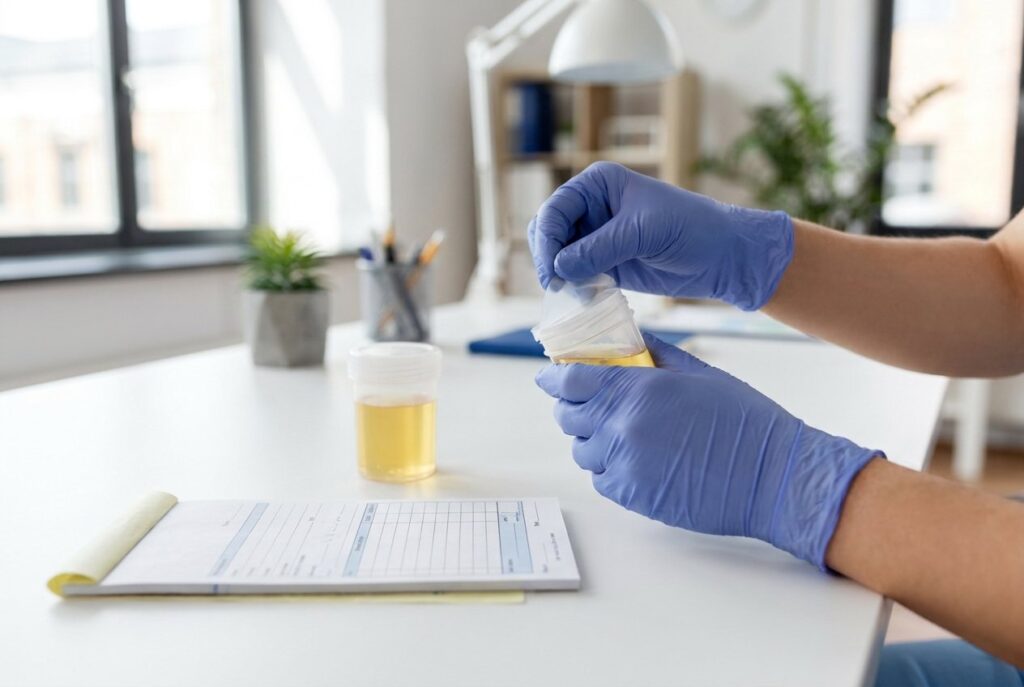
Most DOT urine collections take 15 to 30 minutes. Here is what happens.
- Identity checkThe donor shows a photo ID.
- Federal custody formThe collector starts the Federal Custody and Control Form (CCF), which follows the specimen to the lab and the MRO.
- PreparationThe donor removes outer clothing, empties pockets and washes hands.
- Private provisionThe donor provides at least 45 mL of urine in a secured restroom with tinted toilet water.
- Temperature checkThe collector reads the strip within four minutes. The range is 90 to 100 degrees Fahrenheit; out of range means a new, directly observed collection.
- Split specimenThe urine is poured into Bottle A and Bottle B, sealed with tamper-evident labels the donor initials.
- Signatures and shippingBoth sign the CCF and the specimens ship to a SAMHSA-certified laboratory.
What happens with a shy bladder?
If the donor cannot provide 45 mL, the collector urges them to drink up to 40 ounces of fluid over up to three hours (declining to drink is not a refusal). If there is still not enough after three hours, the employer sends the donor for a medical evaluation. Leaving early can be treated as a refusal.
What happens at the lab and with the MRO?
Every DOT drug test passes through four parties before a result is final.
The laboratory
Bottle A is tested at a SAMHSA-certified (HHS-certified) laboratory. Anything at or above the initial cutoff goes to a more specific confirmation test. The lab also checks for dilution, substitution and adulterants. Bottle B stays sealed.
The Medical Review Officer
The MRO is a licensed physician. For a lab positive, the MRO asks the donor about legitimate explanations such as a valid prescription, then reports the result as negative or verified positive. A donor with a verified positive generally has 72 hours to ask for Bottle B to be tested at a different certified lab.
How long does a DOT drug test take to come back?
Negatives often reach the employer’s designated employer representative (DER) within 24 to 72 hours. Confirmations and MRO interviews take longer. No DOT drug result is available the same day.
Rapid cups can give a preliminary result in as little as 5 minutes, and they are useful for some non-DOT programs. They are never used for DOT testing. Every DOT drug test goes to a SAMHSA-certified laboratory and through MRO review.
What is the FMCSA Clearinghouse and when do you query it?
The FMCSA Drug and Alcohol Clearinghouse is an online database of CDL drivers’ DOT violations: verified positives, refusals and alcohol results of 0.04 or higher. Under 49 CFR 382.701, employers must:
- Run a full pre-employment query, with the driver’s electronic consent in the Clearinghouse, before safety-sensitive work begins.
- Run a query at least once a year on every driver. A limited query is allowed, but if it shows a record, a full query is required within 24 hours.
Owner-operators must designate a consortium/third-party administrator (C/TPA) in the Clearinghouse. A driver with a prohibited status cannot do safety-sensitive work until finishing the return-to-duty process.
What is the difference between a DOT drug test and a regular drug test?
A “regular” or non-DOT test is set by company policy. A DOT test is set by federal regulation.
| Feature | DOT drug test | Non-DOT drug test |
|---|---|---|
| Who requires it | Federal law (FMCSA, FAA, FRA, FTA, PHMSA, USCG) | Employer policy, contracts or insurance |
| Who is tested | Safety-sensitive employees only | Any employee the policy covers |
| Drug panel | Fixed five classes; cannot be changed | Flexible: 5, 10, 12-panel or custom, including fentanyl |
| Specimen | Urine in practice; oral fluid is authorized in the rule but depends on certified lab availability | Urine, oral fluid or hair |
| Form | Federal Custody and Control Form | Non-federal chain-of-custody form |
| Rapid or instant result | Never | Allowed for preliminary screening |
| MRO review | Required | Recommended, depends on the program |
| Clearinghouse reporting | Required for FMCSA drivers | Not reported |
Never use the DOT form or DOT authority for employees who are not DOT-covered, and keep the two programs separate in your written policy. Our post on drug testing for employment covers the policy basics, and for state-law questions check with your employment attorney.

What counts as a refusal to test?
Under 49 CFR 40.191, a refusal carries the same consequences as a verified positive. Common refusals include:
- Not showing up for a test (other than pre-employment) in the time the employer sets.
- Leaving the collection site before the process is complete.
- Refusing a required observed or monitored collection.
- Not providing enough urine with no adequate medical explanation.
- A specimen the MRO verifies as adulterated or substituted.
What happens after a refusal or positive?
The employee is removed from safety-sensitive duty immediately and must complete the SAP process, a directly observed return-to-duty test and follow-up testing before doing that work for any DOT employer. CDL violations are recorded in the Clearinghouse. Whether the employee keeps the job is an employer decision.
How does DOT breath alcohol testing work?
DOT alcohol testing is separate from the drug test, though both often happen at one visit. A certified breath alcohol technician (BAT) uses an evidentiary breath testing device (EBT).
- Below 0.02: negative. The employee can work.
- 0.02 to 0.039: not a violation, but under 49 CFR 382.505 an FMCSA driver cannot perform safety-sensitive work until the next regularly scheduled duty period, and not less than 24 hours after the test.
- 0.04 or higher: a DOT violation. The employee is removed from safety-sensitive duty and must complete the SAP process.
If a screening test shows 0.02 or higher, a confirmation test is run on an EBT after a waiting period of at least 15 minutes and, where possible, within 30 minutes of the screen. Only the confirmation result counts.
How much does a DOT drug test cost in Columbia, SC?
Odosek Mobile DNA & Drug Testing publishes its DOT prices. These are per-test starting prices:
- DOT 5-Panel Collection Only: starting at $45 per test, when you already have your own lab and MRO arrangement.
- DOT 5-Panel Full Service: starting at $87 per test, covering urine collection, SAMHSA-certified laboratory testing and MRO review.
- DOT Breath Alcohol (EBT): starting at $60 per test.
- DOT Consortium Membership: $50 per year per employer.
- Random Pool Management: $35 per driver per year.
- Emergency Post-Accident Dispatch: $250.
Mobile collections at your site add a trip fee that depends on the time and day, starting at $75 during standard weekday hours. Use the drug test pricing calculator to build a quote for your fleet.
How do Midlands employers schedule DOT testing?
Odosek Mobile DNA & Drug Testing has served the Midlands for more than 17 years. Trained, qualified collectors come to your office, terminal or job site in Lexington, Irmo, West Columbia, Blythewood and beyond, 24/7, with same-day collection available. See DOT drug testing in Columbia, SC for consortium membership and random pools through our partner, or drug testing in Columbia for every other workplace test. New drivers can read how to prepare for a mobile drug test.
Odosek Mobile DNA & Drug Testing — Columbia, SC
Mobile and onsite drug testing across Columbia and the SC Midlands, 24 hours a day, 7 days a week. Same-day collection is available throughout the Midlands.
1034 Wildwood Centre Dr, Suite B
Columbia, SC 29229
Columbia, Lexington, Irmo, Cayce, West Columbia, Blythewood, Chapin, Forest Acres, Elgin, Camden, Sumter, Orangeburg
Frequently asked questions
What drugs are on a DOT drug test?
A DOT drug test covers five classes: marijuana metabolites, cocaine, amphetamines (including methamphetamine, MDMA and MDA), opioids (codeine, morphine, 6-acetylmorphine, hydrocodone, hydromorphone, oxycodone and oxymorphone) and PCP. Employers cannot add or remove drugs from a DOT test.
Does a DOT drug test check for fentanyl?
Not as of this writing. The current text of 49 CFR 40.85 does not list fentanyl. DOT proposed adding fentanyl and norfentanyl in 2025, so check the ODAPC website for the current status. Employers who want fentanyl screening can add it to a separate non-DOT program.
Is a DOT drug test urine or hair?
DOT drug tests are urine tests in practice. The rule also authorizes oral fluid, but that depends on certified laboratory availability. Hair testing is not an approved DOT method, though some employers use it in non-DOT programs.
How long does a DOT drug test take?
The collection usually takes 15 to 30 minutes. If the donor cannot provide enough urine, the shy bladder process allows up to three hours. Negative results typically reach the employer in 24 to 72 hours; non-negative results take longer because of confirmation testing and the MRO interview.
What happens if a driver refuses a DOT drug test?
A refusal is treated the same as a verified positive. The driver is removed from safety-sensitive duty and must complete the SAP process, a directly observed return-to-duty test and follow-up testing. For CDL drivers, the refusal is reported to the FMCSA Clearinghouse.
Do small trucking companies in Columbia, SC need a consortium?
Owner-operators must use a consortium or third-party administrator for random testing and Clearinghouse duties. Small fleets are not always required to join one, but most do so their random pool is large enough to meet federal rates. Odosek offers DOT consortium membership through a partner for $50 per year per employer.
Need DOT drug testing in the Midlands?
Odosek sends a trained, qualified collector to your site in Columbia and across the Midlands for pre-employment, random, post-accident and return-to-duty DOT tests, 24/7.
Sources
- 49 CFR Part 40: Procedures for Transportation Workplace Drug and Alcohol Testing Programs (eCFR)
- 49 CFR 40.85: Urine drug test cutoff concentrations (eCFR)
- 49 CFR Part 382: FMCSA controlled substances and alcohol use and testing (eCFR)
- U.S. DOT Office of Drug and Alcohol Policy and Compliance (ODAPC)
- FMCSA Drug and Alcohol Testing Program
- FMCSA Drug and Alcohol Clearinghouse
- SAMHSA Drug-Free Workplace and certified laboratories