
Rapid drug tests: the short answer
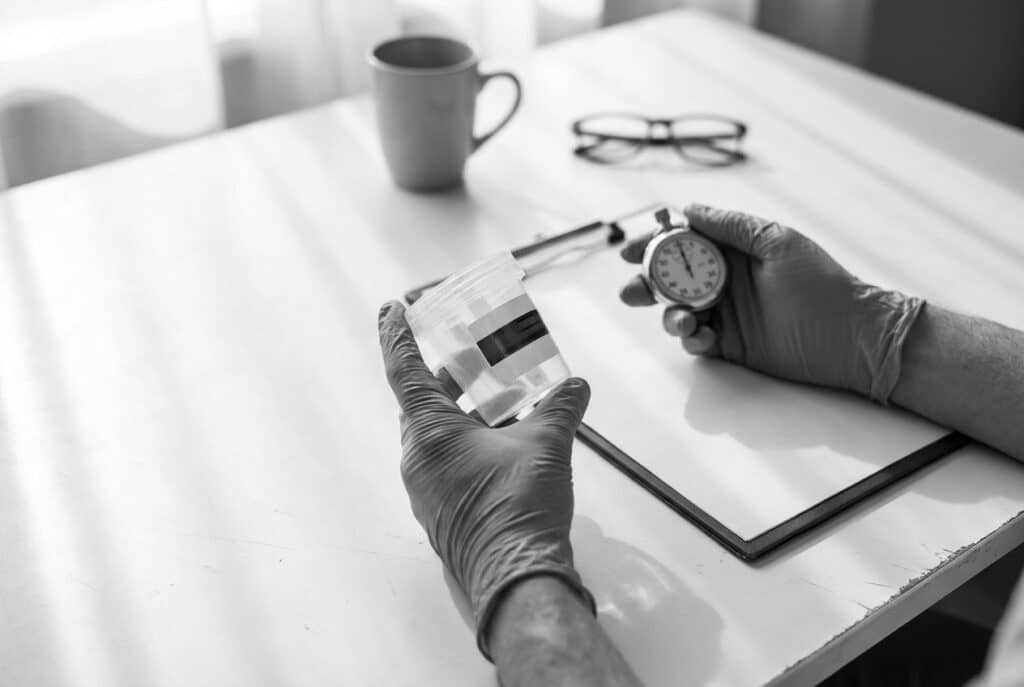
A rapid drug test (also called an instant drug test or rapid drug screen) is a point-of-care urine cup or oral fluid device that gives a preliminary result in as little as 5 minutes. A negative screen lets an employer move quickly on a non-DOT hire. A non-negative screen is not a final result: it goes to a SAMHSA-certified laboratory for GC-MS or LC-MS confirmation and Medical Review Officer (MRO) review, which typically takes 24–72 hours.
- Rapid screens use lateral-flow immunoassay strips. In most urine cups, a visible line in the test zone means negative for that drug.
- Rapid results are preliminary. Only lab confirmation and MRO review produce a verified positive.
- Federal DOT rules do not allow instant or point-of-collection tests. DOT drug tests are always lab-based.
- Best fits: non-DOT pre-employment, non-DOT post-incident and random testing, and high-volume onsite testing events.
- In Columbia, SC, Odosek’s 5-Panel Rapid starts at $65 per test and the 10-Panel Rapid at $95 per test, with GC-MS confirmation at $50 per non-negative specimen.
What is a rapid drug test?
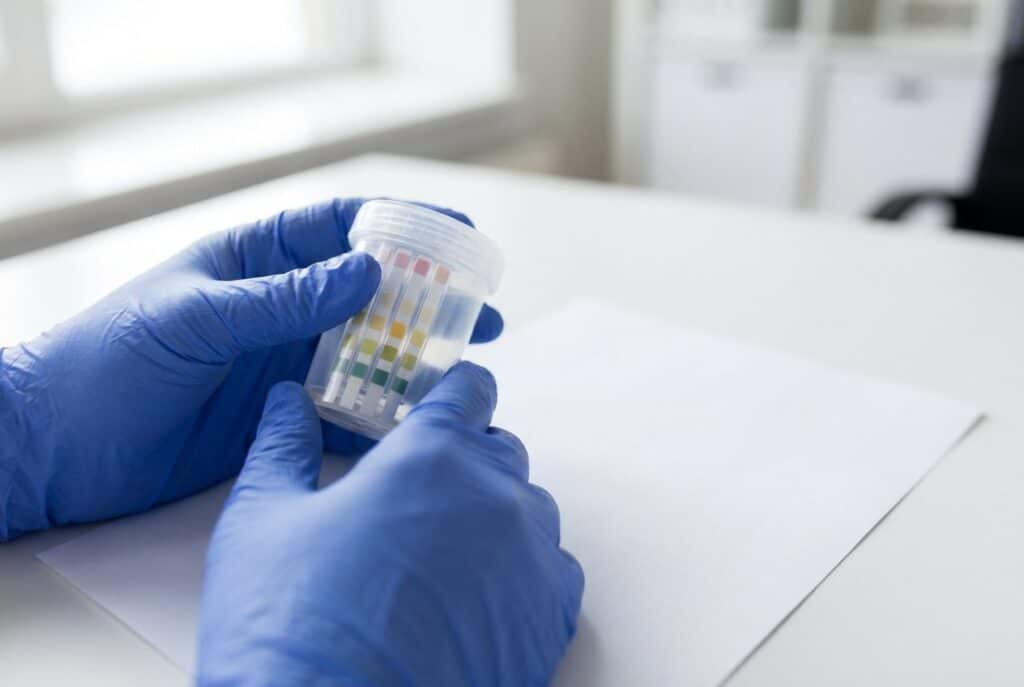
A rapid drug test is a screening device read on the spot instead of at a laboratory. The most common workplace version is an integrated urine cup with test strips built into its wall; oral fluid devices use a swab that feeds a small cassette. Rapid drug screen, instant drug test and point-of-care test (POCT) all mean the same thing: an immunoassay screen performed at the collection site, with a preliminary answer before the donor leaves.
How a lateral-flow immunoassay works
Each strip is a small lateral-flow immunoassay, the same basic technology as home pregnancy tests. Urine wicks up the strip and meets antibodies tagged with a coloured marker. Most drug-test strips are competitive assays: drug in the specimen competes with a drug conjugate fixed on the test line.
- No drug, or drug below the cutoff: the antibodies are free to bind at the test line, so a coloured line forms. That reads as negative.
- Drug at or above the cutoff: the drug ties up the antibodies first, so they can’t bind at the test line, and the line does not form. That reads as a preliminary non-negative.
- Control line: a separate line that should appear every time. It shows the strip ran properly.
So on most drug-test cups, a line in the test zone is good news, the opposite of a pregnancy test. Always follow the device’s package insert, because designs and read times vary.
How do you read a rapid drug test cup?
A trained collector reads the cup within the read window printed on the device’s instructions, usually around 5 minutes. Each drug class on the panel has its own strip, and each strip has a control zone (C) and a test zone (T).
Negative vs non-negative: why the wording matters
Collectors say “non-negative”, not “positive”, on purpose. A rapid screen can only tell you that something in the specimen reacted with the strip at or above its cutoff. It can’t tell you which exact substance caused the reaction, or whether there is a legitimate prescription behind it. That takes laboratory confirmation and an MRO. Treat a non-negative rapid screen as “needs confirmation”, never as a failed test.
What are drug test cutoff levels?
Every drug test works against a cutoff: a concentration in nanograms per milliliter (ng/mL) at or above which a result is non-negative. Below it, the result is reported as negative, even if a trace is present.
There are two kinds. The screening (initial) cutoff applies to the immunoassay, whether that runs on a rapid cup or a lab analyzer. The confirmation cutoff applies to the GC-MS or LC-MS test that identifies the specific drug. Confirmation cutoffs are often lower because the method is far more specific.
The federal benchmark comes from the HHS Mandatory Guidelines, published through SAMHSA and mirrored in the DOT rule at 49 CFR 40.85. A few urine examples from that table:
| Drug class | Initial (screening) cutoff | Confirmation cutoff |
|---|---|---|
| Marijuana metabolites (THCA) | 50 ng/mL | 15 ng/mL |
| Cocaine metabolite (benzoylecgonine) | 150 ng/mL | 100 ng/mL |
| Amphetamine / methamphetamine | 500 ng/mL | 250 ng/mL each |
| Codeine / morphine | 2000 ng/mL | 2000 ng/mL each |
| Oxycodone / oxymorphone | 100 ng/mL | 100 ng/mL each |
| Phencyclidine (PCP) | 25 ng/mL | 25 ng/mL |
Workplace rapid cups are commonly built around similar screening cutoffs, but not every device matches the federal numbers for every drug. Cutoffs are printed in each package insert, so ask your provider which device they use.
How accurate are rapid drug tests?
Rapid screens are good at what they are designed for: quickly sorting specimens into “clearly negative” and “needs a closer look”. They are not the final word. Accuracy varies by device, drug class and how carefully the test is run, and no screen is perfect, which is exactly why a confirmation step exists. For a deeper look at the tradeoffs of testing on site, see our post on the benefits of onsite drug testing.
Can a rapid drug test be wrong? False positives
Yes. The most common cause of a false non-negative is cross-reactivity: the strip reacts with a substance chemically similar to the target drug. Reported examples include certain decongestants on the amphetamine strip, some prescription medications, and poppy seeds on the opiate strip; it depends on the device. That is why rapid screens never stand alone: lab confirmation identifies the actual molecule, and the MRO checks for a valid prescription before anything is reported as positive.
False negatives
A rapid screen can also miss use. Common reasons include:
- Below the cutoff: use was too long ago, or the amount was small, so the concentration is under the screening cutoff.
- Dilution: drinking large amounts of water before the test can lower drug concentrations below the cutoff.
- Not on the panel: a 5-panel cup won’t detect drugs it doesn’t test for, such as many benzodiazepines or synthetic opioids.
- Tampering: adulterants or substituted specimens, which is why validity checks matter.
Why non-negatives go to a SAMHSA-certified laboratory
A non-negative specimen is sealed, documented on a chain-of-custody form and sent to a SAMHSA-certified laboratory. The lab confirms by gas or liquid chromatography with mass spectrometry (GC-MS or LC-MS), which identifies the specific drug and measures it against the confirmation cutoff. A Medical Review Officer, a licensed physician, then reviews the result, contacts the donor about any medical explanation, and reports a verified result. At Odosek Mobile DNA & Drug Testing, GC-MS confirmation of a non-negative specimen is $50 per specimen.
How long does a rapid drug test take?
The read takes about 5 minutes on most devices. What happens next depends on the screen result.
Instant drug test vs lab test: which should you use?
Here is how a rapid screen compares with a lab-based urine test on the factors employers usually ask about.
| Factor | Rapid (instant) screen | Lab-based test |
|---|---|---|
| Speed | Preliminary result in as little as 5 minutes | Typically 24–72 hours |
| Starting price at Odosek | 5-Panel $65; 10-Panel $95 per test | 5-Panel $65; 10-Panel $89 per test |
| Confirmation | Non-negatives sent to the lab ($50 GC-MS confirmation) | Built in: screen and confirmation both at the lab |
| Who identifies the drug | Strip shows a drug class only | GC-MS or LC-MS identifies the specific drug |
| Legal defensibility | Preliminary on its own; defensible once confirmed and MRO-verified | Strongest: lab chain of custody from the start |
| Allowed for DOT? | No, never | Yes (DOT tests must be lab-based) |
| Best for | Non-DOT hiring, events, quick decisions | DOT, court, disputed or high-stakes results |
A 5-Panel rapid and a 5-Panel lab urine test both start at $65 per test: the rapid test buys speed on negatives, not a lower price. Run your own numbers with the drug test pricing calculator. For a broader look at specimen types, see our urine drug testing page.
When should Columbia SC employers use a rapid drug test?
Rapid screens shine when speed matters and the program is not federally regulated. Common uses we see across the Midlands:
- Non-DOT pre-employment: a negative lets a warehouse, restaurant or staffing agency start a new hire the same day, under its own policy.
- Non-DOT post-incident: a quick preliminary read after a workplace incident, with any non-negative confirmed at the lab.
- Non-DOT random testing: short, low-disruption visits to a site in Lexington, Irmo or West Columbia.
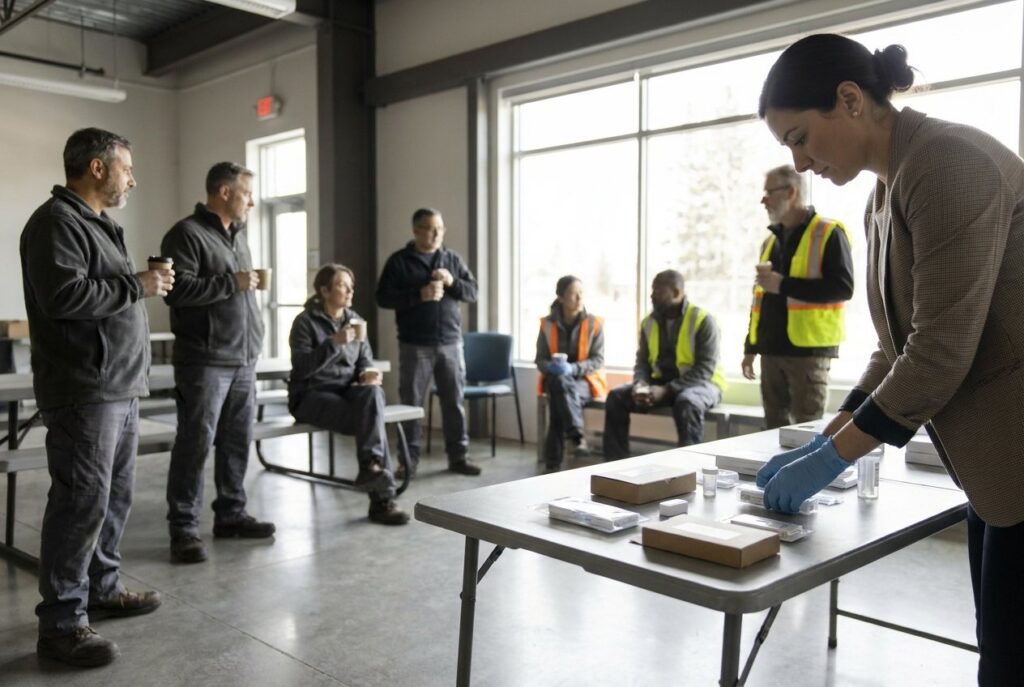
- High-volume onsite events: testing dozens of workers at a plant or job site in one visit, so negatives are sorted on the spot.
All of these fall under non-DOT drug testing, where employer policy, not federal rule, sets the testing method. Our employer drug testing program helps you decide which situations use rapid screens and which go straight to the lab.
When should you not use a rapid drug test?
Skip the rapid screen when you need a lab chain-of-custody result from the start:
- DOT-regulated testing. DOT-covered employees must be tested at an HHS-certified (SAMHSA-certified) laboratory. 49 CFR 40.210 states that point-of-collection urine, point-of-collection oral fluid and instant tests are not authorized.
- Court and legal matters. Custody, probation and other court-related testing usually needs a lab-based chain-of-custody result. Check what the court or attorney requires.
- Anything likely to be disputed, such as results that may reach a grievance or hearing.
- Expanded or specialty panels. 12-panel and expanded panels are available; ask for a quote and whether they are lab-based.
Rapid screens are never used for DOT results. State law, ADA, prescription medication and marijuana questions can affect how you act on a result; this article is general information, so check with your employment attorney. As of this writing, South Carolina has not legalized recreational marijuana.
How do collectors check for cheating on a rapid test?
A rapid result is only as good as the specimen. Trained, qualified collectors use these validity checks:
- Temperature: most rapid cups have a temperature strip. A fresh specimen should read roughly 90–100 °F; the federal rule for lab collections uses that same range, read within four minutes of collection.
- Adulterant strips: some cups include integrated validity strips that flag abnormal creatinine, pH, specific gravity or oxidants. Not every device has them, so ask.
- Collection controls: bluing agent in the toilet, secured water sources, and bags left outside.
- Observed collection: when policy calls for it, an observed collection is available for $35.
Oral fluid rapid test vs urine rapid test
- Urine rapid cups detect drug metabolites over a wider window, often a few days for many drugs, and are the most familiar format for employers.
- Oral fluid rapid devices mostly detect recent use, roughly the last day or two for many drugs. Every collection is observed by nature, which makes substitution much harder, and no restroom is needed.
Oral fluid suits post-incident checks where recent use is the question, and job sites with no restroom. Learn more on our saliva and oral fluid drug testing page; oral fluid panels start at $80 per test (9-panel), and the oral fluid 10-panel at $99 does not include fentanyl.
What does a rapid drug test cost in Columbia, SC?
Odosek Mobile DNA & Drug Testing publishes its prices. Rapid screens start at:
- 5-Panel Urine Rapid/Instant: $65 per test. See what’s included on our 5-panel drug testing page.
- 10-Panel Urine Rapid/Instant: $95 per test. Compare drug classes on our 10-panel drug testing page.
- GC-MS confirmation: $50 per non-negative specimen.
- Mobile trip fee: $75 standard hours (Monday–Friday, 8am–5pm), $100 extended hours (5–9pm), $150 after hours (9pm–7am), $135 Saturday and $175 Sunday or holiday. Emergency post-accident dispatch is $250.
Because a collector comes to you, testing a group in one visit spreads the trip fee across everyone tested. Our onsite drug testing service covers offices, plants and job sites in Columbia, Blythewood, Chapin, Cayce, Camden, Sumter and Orangeburg, 24 hours a day, with same-day collection available throughout the Midlands. With more than 17 years serving the area and a 5.0-star Google rating, we send every non-negative to a SAMHSA-certified laboratory for confirmation. See all services on the main Columbia, SC drug testing page.
More in this series: What a DOT drug test includes | Pre-employment drug screening for SC employers
Odosek Mobile DNA & Drug Testing — Columbia, SC
Mobile and onsite drug testing across Columbia and the SC Midlands, 24 hours a day, 7 days a week. Same-day collection is available throughout the Midlands.
1034 Wildwood Centre Dr, Suite B
Columbia, SC 29229
Columbia, Lexington, Irmo, Cayce, West Columbia, Blythewood, Chapin, Forest Acres, Elgin, Camden, Sumter, Orangeburg
Frequently asked questions
How long does a rapid drug test take?
Most rapid cups are read about 5 minutes after collection, so a preliminary result is available in as little as 5 minutes. If the screen is non-negative, the specimen goes to a SAMHSA-certified laboratory, and a lab-confirmed, MRO-verified result typically takes 24–72 hours.
How accurate are rapid drug tests?
Rapid screens reliably sort clear negatives from specimens that need a closer look, but no screen is perfect. Cross-reacting medications can cause false non-negatives, and dilution can cause false negatives, so non-negatives are confirmed by GC-MS or LC-MS and reviewed by an MRO.
Can a rapid drug test be wrong?
Yes. A rapid screen can react to a substance that is chemically similar to the target drug, such as certain medications, or miss a drug that is below the cutoff or not on the panel. A rapid result is preliminary, and only a lab-confirmed, MRO-verified result should be treated as a positive.
On a rapid drug test, does one line mean negative?
On most rapid urine cups, two lines (control and test) mean negative, even if the test line is faint. A control line with no test line is a preliminary non-negative that needs lab confirmation. No control line means the strip is invalid. Always check the device’s instructions, because designs vary.
If I pass a rapid drug test, will I pass a lab test?
Not necessarily. Lab tests may use different cutoffs and test for more drugs. A negative rapid screen is a good sign, but it does not promise a negative lab result.
Can rapid drug tests be used for DOT testing?
No. Federal DOT rules at 49 CFR 40.210 do not authorize point-of-collection or instant tests. DOT drug tests must be collected under Part 40 procedures and tested at an HHS-certified (SAMHSA-certified) laboratory with MRO review.
How much does a rapid drug test cost in Columbia, SC?
At Odosek, a 5-Panel Rapid starts at $65 per test and a 10-Panel Rapid at $95 per test. GC-MS confirmation of a non-negative is $50, plus a mobile trip fee starting at $75 on weekdays during standard hours.
Need rapid drug screens in Columbia or the Midlands?
Our trained, qualified collectors come to your office, plant or job site 24/7, with same-day collection across the Midlands. Get preliminary results in minutes and lab confirmation when you need it.